

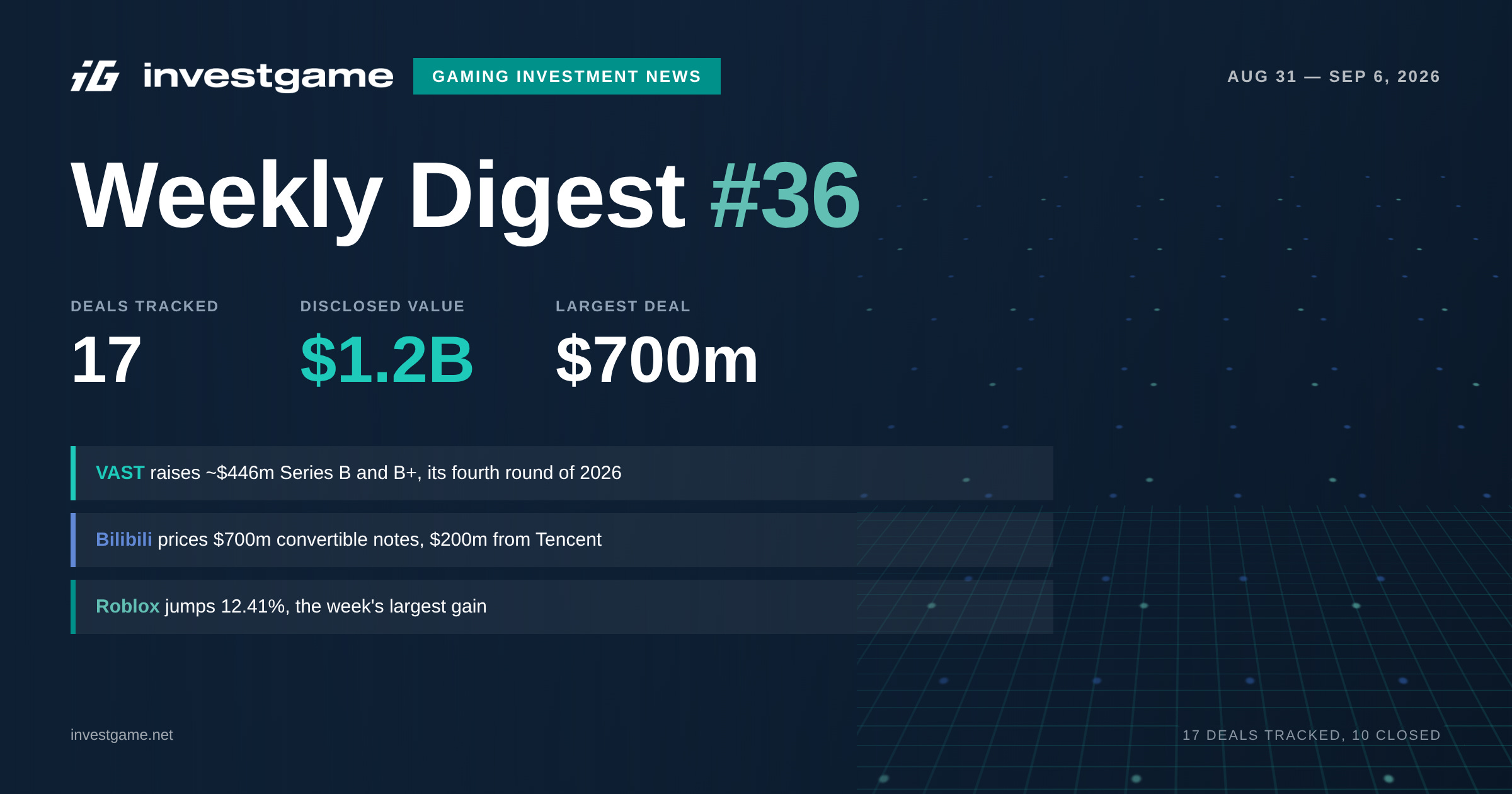
InvestGame tracked 17 deals worth $1.2B this week. 10 closed. Below are the top 11.
Matrix Partners China has led a ~$446m Series B and B+ into VAST, maker of Tripo AI, in its fourth round of 2026
China-based generative 3D AI company VAST, developer of the 3D asset generator Tripo AI, has raised ~$446m (~RMB 3B) in a Series B and Series B+ round led by Matrix Partners China, announced on Sep 1, 2026. The strategic investors are games publishers Perfect World (SZSE: 002624), 37 Interactive Entertainment (SZSE: 002555), and Yanqu Games; the marketing group BlueFocus (SZSE: 300058); the software company ThunderSoft (SZSE: 300496); and the semiconductor investor SPC. Financial investors CDH VGC, CICC Capital, CMC Capital, Hongtai Aplus, 3H Health Investment, Zhongping Capital, and GreatOrigin Asia joined, and existing backers Fortune Capital, Primavera Capital, 4399 Network, Muhua Tech Ventures, Vitalbridge Capital, INCE Capital, and T-Capital topped up. Proceeds fund 3D-native foundation models, 3D data infrastructure, training and inference compute, and commercialization.
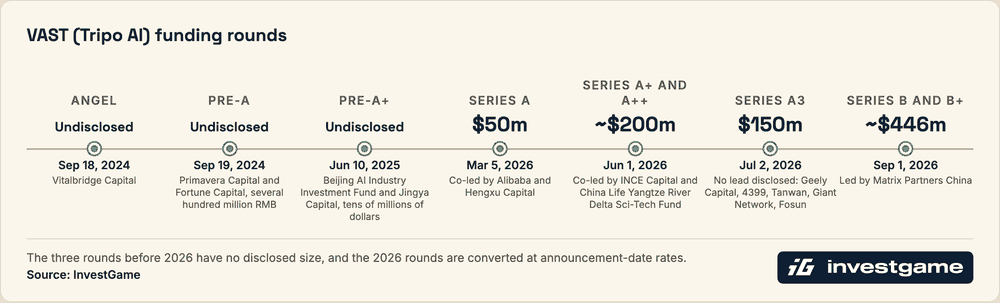
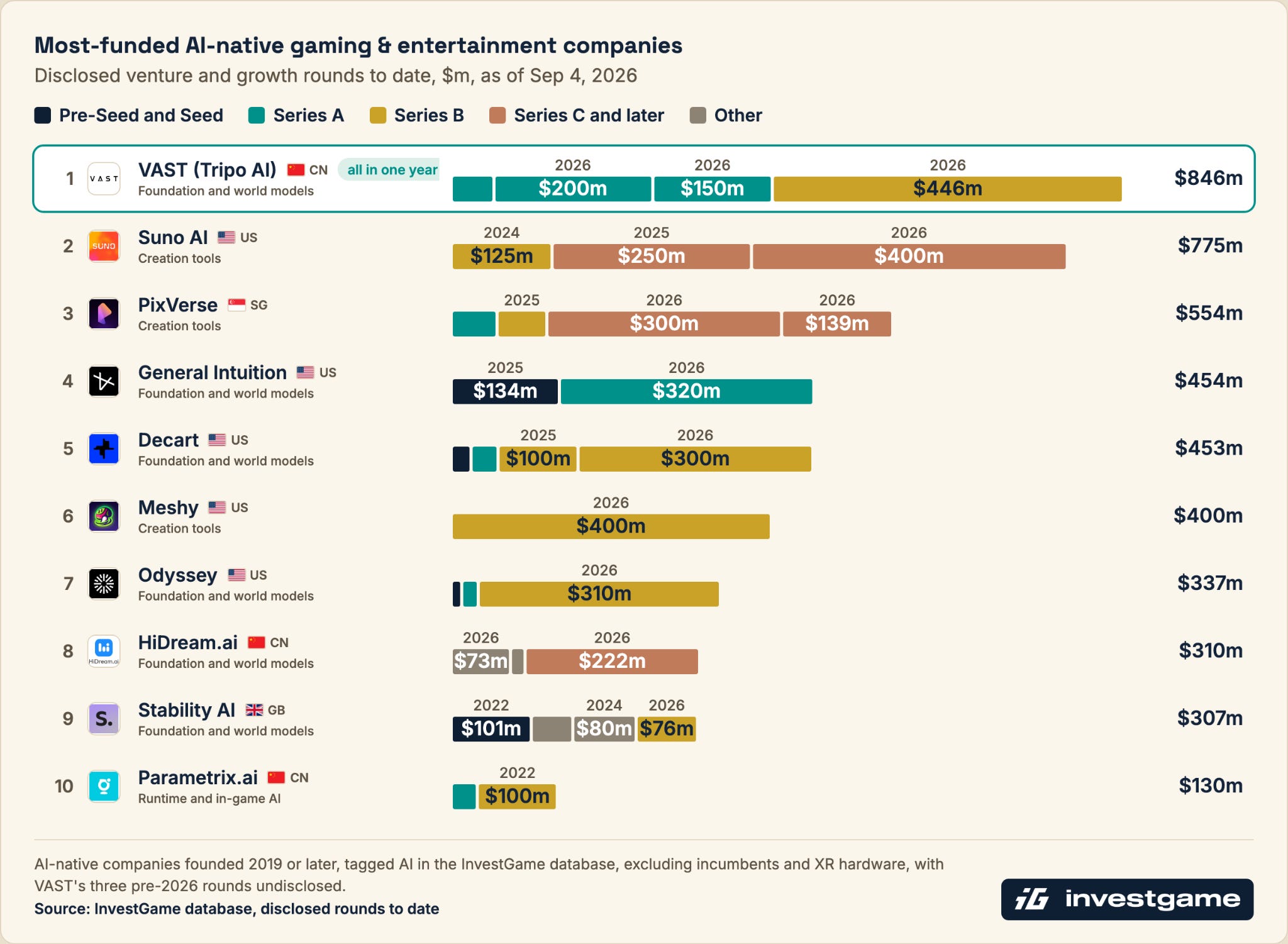
It is VAST’s fourth round of 2026 and more than twice the size of any of the other three. The ladder runs from a $50m Series A co-led by Alibaba (NYSE: BABA) and Hengxu Capital in Mar’26, through a ~$200m Series A+ and A++ co-led by INCE Capital and China Life Yangtze River Delta Sci-Tech Fund in Jun’26, which Bloomberg reported at a valuation of at least $1.0B, to a $150m Series A3 in Jul’26 from Geely Capital, 4399, Tanwan (SEHK: 9890), Giant Network (SZSE: 002558) and Fosun Capital. Its total in less than six months, as 36kr reports, is ~RMB 5B (~$744m), which the company calls a record for AI 3D. The four rounds put VAST first among AI-native companies in gaming and entertainment, at ~$846m of disclosed funding to date, ahead of Suno AI at $775m and PixVerse at $554m.
The investors in this round are increasingly the same games companies that use its tools. The Mar’26 round was backed by internet groups: Alibaba co-led it, and Baidu Ventures joined. Jul’26 brought the first three games companies, 4399, Tanwan and Giant Network. This round adds Perfect World, 37 Interactive, and Yanqu, and 4399 returns for a second check. The enterprise API base stood at 700+ customers and 35,000 active developers, with the creator base at 3 million in Aug’25, and reached 6.5 million by Dec’25. VAST’s Series A release counted 6.5 million creators, 90,000 developers and ~100 million generated assets by Mar’26, and Forbes put users at 20 million by Jun’26, mostly in the US, Europe and Japan, paying $20 to $90 a month (billed annually) on the consumer side and per-project fees on the enterprise side.
Studios use Tripo to turn a text prompt or a concept image into a finished 3D object or character that can be dropped into a game engine as a prop, character, or environment asset. NetEase (NASDAQ: NTES) runs it in two live games, Eggy Party and Where Winds Meet, and Tencent (SEHK: 700), ByteDance, and Microsoft (NASDAQ: MSFT) use it in internal workflows via the enterprise API. The new P2.0 model, announced with the round, produces assets in the mesh format studios’ animation tools expect, so less manual clean-up is needed before an asset is usable.
VAST has disclosed neither a post-money valuation for this round nor revenue. The WSJ reported in August that VAST sought the round at nearly $2.0B. The priced comparable is Meshy, which raised nearly $400m at a $1.5B valuation in Jul’26, co-led by IDG Capital, Matrix Partners China and Monolith Management, on ~$60m in ARR and 12 million registered users. Matrix Partners China has therefore led the two largest rounds in AI 3D, six weeks apart, on both sides of the rivalry.
Bloomberg reported on Aug 4 that VAST is weighing a Hong Kong IPO with Bank of America (NYSE: BAC) and CICC (SEHK: 3908) at a preliminary stage, and the WSJ said the listing could occur as soon as 2027. CICC Capital, the bank’s private-equity arm, is in this round. Founder and CEO Simon Song co-founded MiniMax (SEHK: 100), which listed in Hong Kong in Jan’26, and Chief Scientist Yanpei Cao led 3D generation at Tencent’s ARC Lab before VAST. InvestGame will continue monitoring the AI 3D category and whether a Hong Kong listing prices VAST at a level above Meshy’s $1.5B.
MERGERS & ACQUISITIONS
US-based classic games IP holder and publisher Piko Interactive has acquired Thailand-based indie games developer and publisher 7 Raven Studios for an undisclosed sum. Founded in 2006, 7 Raven has self-published on Xbox, PlayStation, and Switch since 2017, released the pixel-art Metroidvania The Skylia Prophecy in 2021, and continues as a development and publishing label under Piko. Piko, founded in 2013 by President Eli Galindo, holds over 180 video game, cartoon, toy, and comic IPs from the 1980s and 1990s. 7 Raven will build new original IP and new games on that catalog. As Galindo stated, “The next step is creating new games with it.” The two first worked together in 2015, when Piko published 7 Raven’s Game Boy Advance role-playing game Broken Circle.
UK-based game modding platform Nexus Mods, owned by Denmark-based gaming holding Chosen since Jun’25, has acquired SteamDB, the donation-funded third-party database of the Steam catalog, for an undisclosed sum. Founded in 2013 by Pavel Djundik and Martin Benjamins, SteamDB tracks the builds, depots, and update history of every Steam game, along with player counts and price history. Nexus Mods, which counts 78 million members and 25 billion downloads, will use that version-level data to let its mod manager flag mods built for a different game build and to pin exact game versions in Collections. Djundik stays on through a transition over the coming months. SteamDB commits to staying free, keeping all current features outside a paywall, and running no display ads, with revenue coming from publisher partnerships, integrations, and affiliate links.
UK-based sports movement-intelligence platform Hitai has acquired the technology and intellectual property of UK-based fitness gaming developer Quell for an undisclosed sum. The assets comprise Quell’s camera-less motion-recognition models, the firmware and hardware stack of its Impact fitness console, and its launch title Shardfall, a fantasy combat action RPG built around 20-minute HIIT sessions. Quell, founded in 2020, raised $15.6m in total, including a $10m Series A led by Tencent (SEHK: 700) in Feb’23. Quell entered a company voluntary arrangement in Oct’25 and remains registered as active.
China-based games publisher 4399 has taken a 22% stake in newly founded Guangzhou-based studio Zhuwei Network for an undisclosed sum. Founder Chen Ge was the founding lead designer of NetEase’s (NASDAQ: NTES) mobile strategy title Infinite Borders, and Zhuwei is building an open-world strategy game. Chen’s earlier venture took financing from South Korea-based publisher Nexus (KOSDAQ: 205500). For 4399, which joined VAST’s rounds in July and this week, it is a rare game-development bet after a year of AI-focused investments.
VENTURE FINANCING
[CONSUMER APPS / NON-GAMING] Türkiye-based consumer apps company HubX has raised $50m from Point72 Private Investments at a $1.2B pre-money valuation, with an option for a further $25m, in its first external financing. Founded in 2022 in Izmir, HubX operates more than 40 AI-native consumer apps with over 600 million downloads. Proceeds fund an acquisition engine for consumer-app teams. HubX follows games companies Peak Games, sold to Zynga for $1.8B in 2020, and Dream Games, a unicorn since 2021, into Türkiye’s unicorn line.
US-based fintech company CreatorFi has raised $45m in combined debt and equity financing, with capacity for a further $100m. EV3 led the equity round and VerisFi Capital the debt round, with participation from Uncorrelated Ventures and Protagonist. CreatorFi advances capital against recurring platform revenue, from game earnings to music royalties, repaid as a share of platform payouts. For games studios, it offers debt facilities of $200k to $20m+ with no equity taken: user acquisition financing underwritten on a studio’s whole portfolio revenue rather than the funded cohort, minimum-guarantee financing against licensing revenue, and growth capital for multi-title studios, on Roblox (NYSE: RBLX), Fortnite, Minecraft, mobile, PC & Consoles. Launched in Jul’25 by co-founders Billy Huang, CEO, and Jack Cameron out of Insomnia Labs, CreatorFi previously secured a $12m credit facility from Kamui Finance and others.
South Korea-based games publisher Kakao Games (KOSDAQ: 293490) has made a strategic investment of an undisclosed size in BackendX, a Seoul-based platform whose ~50 AI agents turn natural-language requirements into a deployed backend. Founded in 2025 by CEO Moon Dae-kyung, formerly CEO of game-server engine developer iFun Factory, BackendX is pre-launch. Kakao Games plans to offer the tool to studios under its publishing contracts. Nexus (KOSDAQ: 205500) invested in Sep’25, making Kakao Games the second strategic backer.
Israel-based consumer technology company Particula, maker of app-connected toys, has raised $15m in a growth round led by Elah Fund, with existing investors Grove Ventures and Flashpoint returning. Proceeds go to product development, hiring, and international expansion. Founded in 2017 by CEO Udi Dor, Particula has sold more than 1 million units across four lines: the app-connected Rubik’s Cube GoCube, the robotic chess board GoChess, the app-connected dice GoDice, and the balance board GoBalance, and has moved from direct-to-consumer sales into national and specialty retail. Its Harry Potter edition, GoChess Wizard, is licensed from Warner Bros. under a partnership announced in Aug’25. Flashpoint led Particula’s $5m Series A in Feb’21, and the 2023 GoChess Kickstarter raised $2.1m.
Saudi Arabia-based mobile games developer TakaHouse has raised $1.5m from Impact46, which runs a $40m (SAR 150m) gaming fund set up with the National Development Fund and the Social Development Bank in Mar’24. Founded in 2018 in Riyadh by CEO Salman S Nasser, the studio launched the social card game WhistGame in 2021, which has more than 140,000 users, and will use the funds to develop new titles beyond it.
PUBLIC OFFERINGS
China-based video platform Bilibili (NASDAQ: BILI, SEHK: 9626) has priced $700m of zero-coupon convertible senior notes due Sep 15, 2031, of which $200m was subscribed by Tencent (SEHK: 700). Alongside the notes, Bilibili authorized a $300m buyback: a $100m delta buyback of shares sold in the concurrent hedging placement, and $200m to repurchase Tencent’s own Class Z shares so its stake does not rise, subject to shareholder approval at an upcoming general meeting. Proceeds fund AI-driven product investment in content recommendation and creation tools, plus general corporate purposes. Mobile games brought in $205.1m, 18% of second-quarter revenue, the only segment to decline.
UA FINANCING
US-based mobile games developer Burlingame Studios has secured $12m in non-dilutive UA financing from Singapore-based PvX Partners, announced Sep 3, 2026, alongside the rebrand of its flagship title to the design-and-decor simulation Flourish by Garden Joy. Since its launch in Mar’23, the game has generated $22.7m in lifetime in-app purchase revenue from 4.3 million downloads, according to AppMagic. Founded by CEO Chris McGill, previously SVP and General Manager at Glu Mobile, with four colleagues from CrowdStar and Glu Mobile, the studio took a $20m investment from Scopely in Mar’22, when it was newly formed.
FUNDRAISING
Saudi Arabia-based development finance institution National Development Fund has approved, per an Aug 24 update, more than $112m (SAR 421m) of financing through its Gaming and Esports Financing Program since its Sep’22 launch, reaching 82 companies and more than 127 games as of the end of 2025. The program runs through the Social Development Bank, which lends up to $12m (SAR 45m) per company for working capital and capex. Equity comes through two SDB-anchored venture funds signed in Mar’24: the $80m (SAR 300m) Merak Capital gaming fund and the $40m (SAR 150m) Impact46 fund.
The Dubai Films and Games Commission has announced a game-studio accelerator with US-based video game commerce platform Xsolla, launching in Oct’26 and extending their May’26 partnership. Dubai also becomes the second permanent Xsolla Club after Tel Aviv. Games Commissioner Faisal Kazim targets studios that can ship a game but have yet to close deals with larger publishers and investors.
EARNINGS REPORTS
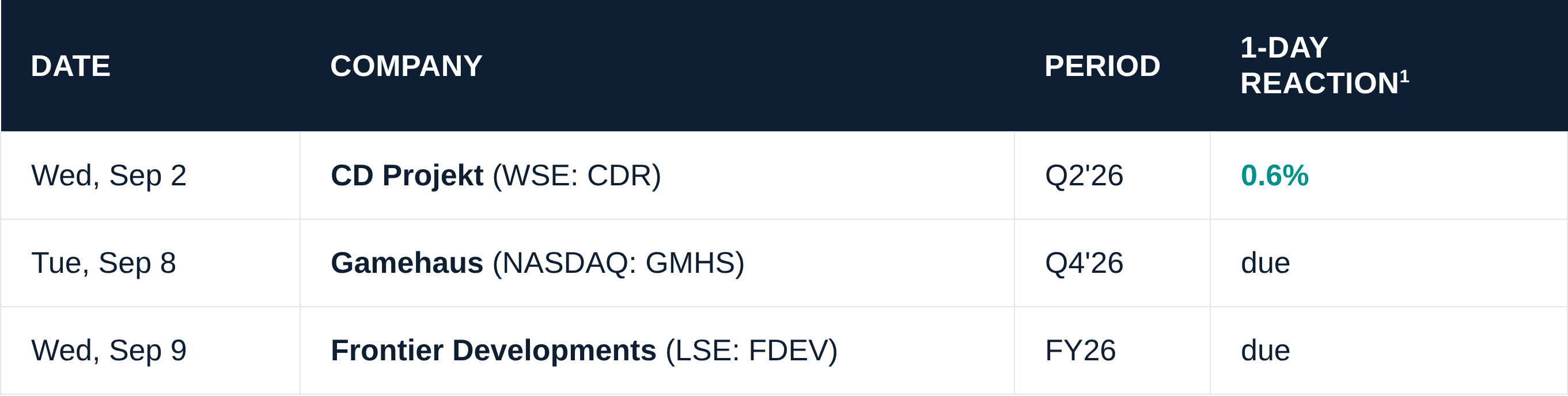
(1) Close-to-close move around the report date. Due dates are set by the issuer and may change. Source: company releases and exchange closes.
CD Projekt beat expectations on both lines in Q2: revenue of $65m came in 22% above consensus, and net profit of $38m came in 44% above, on licensing income that rose about tenfold year on year to $25m in the first half. The shares moved only 0.6% because the growth came from the back catalog and licensing rather than a new release: the company reports that The Witcher 3 has passed 65m copies and the series 90m, while Cyberpunk 2077 has passed 40m with Phantom Liberty at 15m. The pipeline is now one Witcher release a year: The Witcher 3: Wild Hunt Remastered on Sep 29, the Songs of the Past expansion in 2027, and The Witcher 4 in 2028.
Public Market Performance
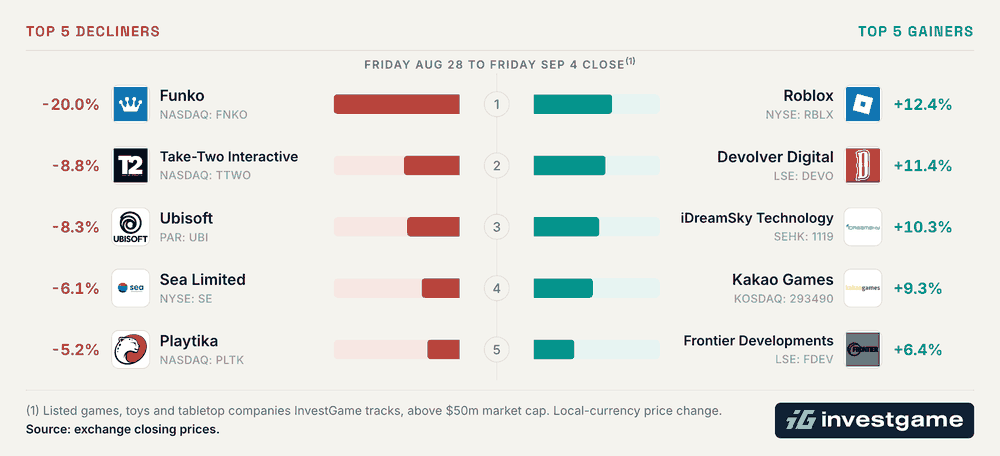
It was a negative week for the tracked universe: of 64 eligible companies, 25 rose, 38 fell, and 1 was flat, with a median move of -1.3%, over the Friday, Aug 28 to Friday, Sep 4 window.
Share Price Signals
Roblox (NYSE: RBLX) (+12.41%) rose in two trading sessions. On Aug 31, the European Commission designated Roblox as a Very Large Online Platform under the Digital Services Act, noting that it has at least 45 million average monthly users in the bloc, with compliance due by Jan’27. Then, after the close on Sep 3, Roblox published its 2025 Economic Impact Reports: creators earned over $1.5B in 2025, up from $923m in 2024, and US creators generated $752m in GDP impact, up 69% from 2024.
Devolver Digital (LSE: DEVO) (+11.40%) climbed into the deadline for its own tender offer. The indie publisher is canceling its AIM admission and will buy back about 4.71% of its issued capital at 16 pence a share, returning up to $5.0m in cash. Elections had to be in by 4.00 p.m. on Sep 3, with the shareholder vote and the tender close both set for Sep 8 and dealings ending Sep 15. Shares went from 7.75p on Sep 1 to 8.50p on Sep 3, still well under the 16 pence tender price. The directors and their concert party, on 31.45% of the capital, have undertaken not to tender.
iDreamSky Technology (SEHK: 1119) (+10.34%) resumed its climb this week, extending a rally that began before the Hong Kong-listed mobile games publisher released H1 2026 results on Aug 27. Revenue rose 4.7% to RMB 718.3m from RMB 685.8m, but profit attributable to equity holders fell 23.5% to RMB 21.8m and basic EPS dropped 40.6% to RMB 0.01, a mixed print that nonetheless kept buyers in the stock. Shares dipped to HK$0.435 on Aug 28, the day after the results, then recovered to HK$0.52 by Sep 3 and closed the week at HK$0.48. The stock had already risen 61.1% in the month before the results, and Simply Wall St flagged the thinning profitability behind that run.
Frontier Developments (LSE: FDEV) (+6.41%) rose after the Planet Coaster and Planet Zoo studio announced on Sep 3 a new game built on Disney’s intellectual property, fully funded by Frontier itself. The companies disclosed no financial terms. CEO Jo Cooke called it a fit with Frontier’s creative-management-simulation strategy, the genre behind Planet Coaster, Planet Zoo, and Jurassic World Evolution. Coverage across the games press read it as a likely theme-park management sim, given the studio’s back catalog.
Take-Two Interactive (NASDAQ: TTWO) (-8.79%) extended its slide as the Grand Theft Auto VI leak fallout continued. Shares have fallen more than 19% from their early-July high near $266, placing them firmly in correction territory, and closed the week at $214.69. Take-Two’s legal pursuit of the leaker escalated on Sep 1, when a New York federal court granted a new, narrower subpoena naming specific individuals, after the company had already withdrawn its original YouTube request under a judge’s pushback. Rockstar called the breach heartbreaking. Bank of America analysts said the leaked footage was impressive but unlikely to move their estimates. The leak has not dented anticipation for the Nov 19 launch: Rockstar’s official 27-minute preview drew 31.1 million Netflix views in four days.
Go Premium
Last week's Premium Digest #35 covered Verve's -22%, Godot overtaking Unity, and AdTech -45% YTD.