

InvestGame tracked 15 newly announced deals worth $510.5m this week; 18 deals closed. Below are the top 8.
Tencent has led an $18m Series B into W4 Games, founded by the creators of the open-source Godot Engine
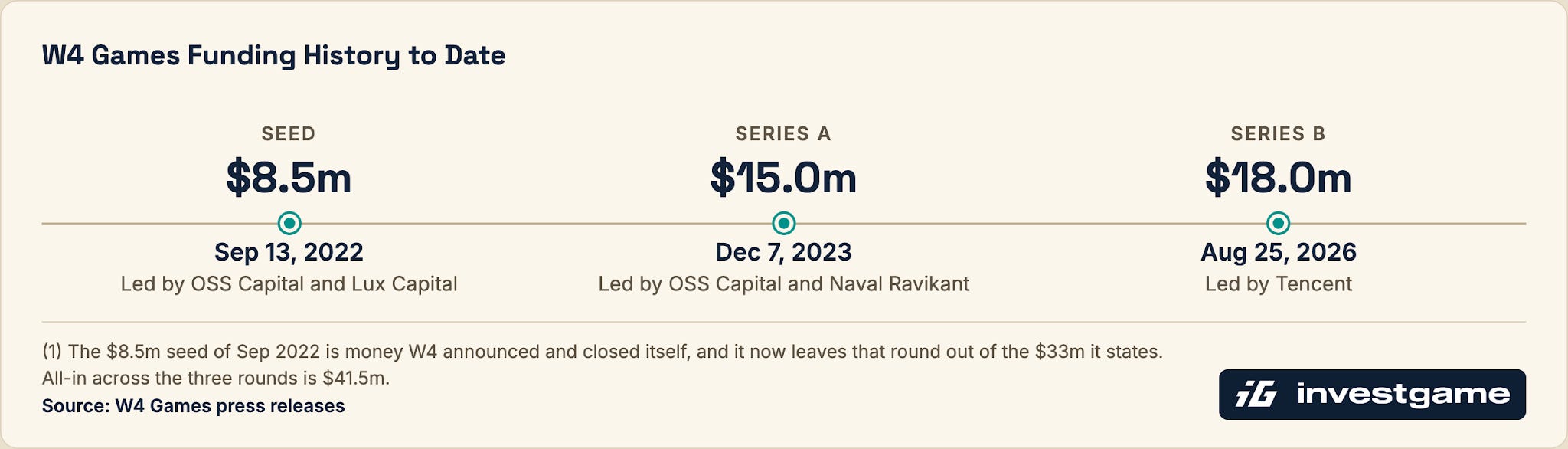
Ireland-based game engine developer W4 Games has raised $18.0m in a Series B led by Tencent (SEHK: 700), with existing backers OSS Capital, Lux Capital, Naval Ravikant and Tobias Lütke’s family office. Announced on Aug 25, 2026, it includes a multi-year strategic partnership with Tencent to scale W4’s business and the Godot ecosystem in Asia, covering go-to-market, localization, ecosystem support, advocacy, and market development among developers in the region. Proceeds would also fund a 50% increase in W4’s international team, about 30 people today across around 20 cities, with 10 to 15 full-time hires planned over the next 12 months.
W4 puts total funding raised to date at $33m, comprising its $15.0m Series A in Dec’23 plus this round. Its $8.5m Seed of Sep’22, which W4 announced earlier, is not in that figure, and including it brings the all-in total to $41.5m.
W4 was founded in 2021 in Dublin by Godot creator Juan Linietsky, project manager Rémi Verschelde, Fabio Alessandrelli, and Nicola Farronato, with Linietsky and Farronato as co-CEOs. Today, the company sells W4 Consoles, approved porting middleware for Nintendo Switch, Xbox Series X|S and PlayStation 5, alongside engine consulting, XR integration and enterprise support. Godot itself is a free, MIT-licensed game engine operated by the Godot Foundation, a Dutch non-profit organization.
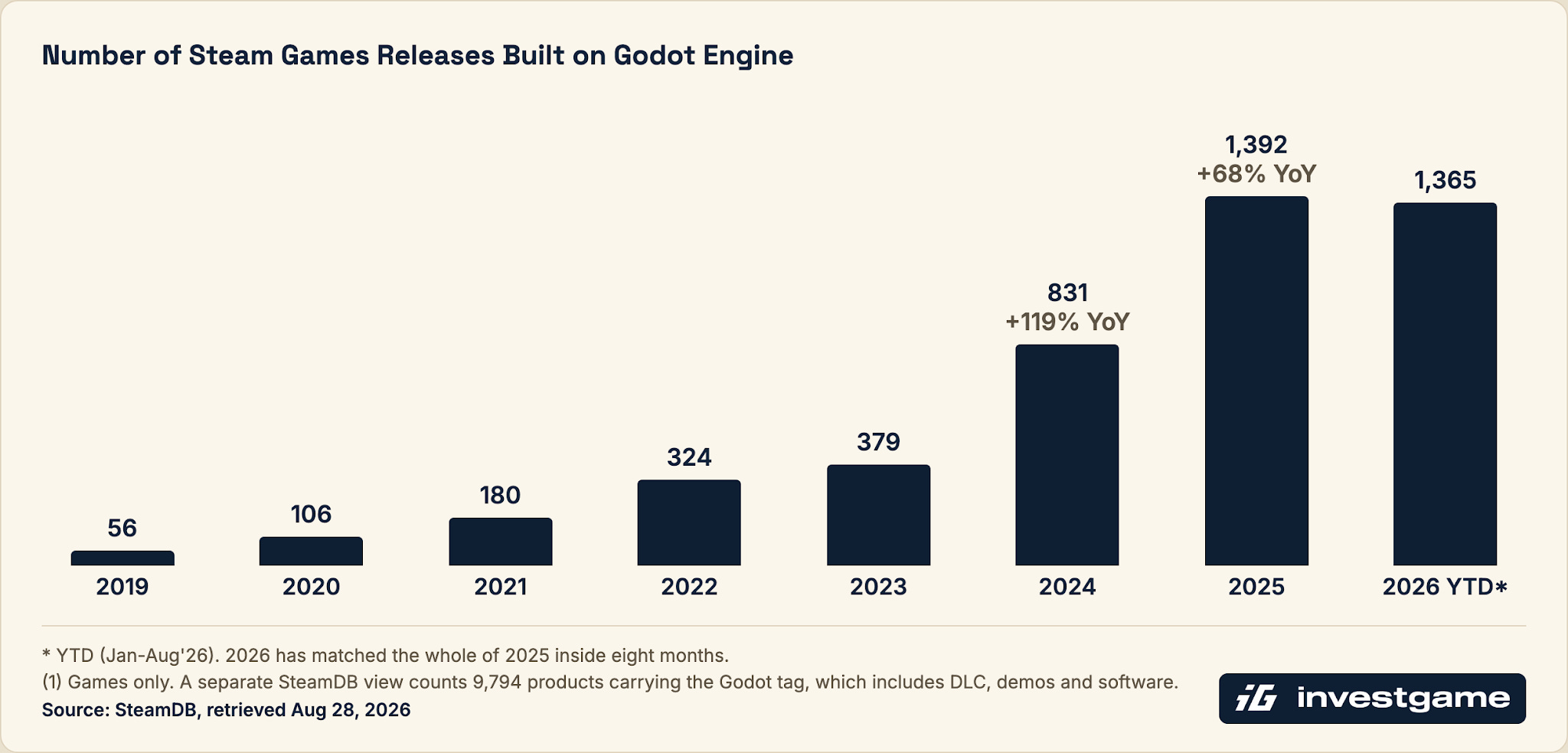
Godot’s adoption is what the round is underwriting, and it compounds. Titles shipped on Steam roughly quadrupled between 2023 and 2025, and 2026 matched the whole of 2025 in the first eight months. At GMTK Game Jam 2026 in Jul’26, Godot took 47% of roughly 10,500 entries against Unity’s 34%, the first time in ten runs that Unity was not the most-used engine there. According to Gamalytic data, the number of Godot games with more than $1m in annual sales has increased from 2 to more than 50 over three years. Some well-known games built on the Godot engine include:
Slay the Spire 2, sequel to one of the genre’s defining deckbuilders, entered Steam Early Access on Godot in Mar’26 and peaked at ~575k concurrent players, the 20th-highest all-time Steam peak;
According to Alinea Analytics, Buckshot Roulette, also built in Godot, has sold more than 10 million copies across PC and Xbox since its Dec’23 debut.
One of its competitors, US-based Unity Software, reported Q2’26 Strategic Create revenue (the Create Solutions segment, covering Unity Editor licenses, developer subscriptions, and related engine tools) of $157.5m, up 5% YoY as reported, or 14% excluding a $12m one-off item in the Q2’25 base, the engine line Godot competes with. Godot’s Steam ramp begins the year after Unity’s Sep’23 runtime-fee pricing change, which cost Unity 19% of its value in ten days and was later canceled outright.
Farronato told GamesBeat that the China opportunity exists “in part because Unity decided to pull out,” and told GamesIndustry.biz that W4 chose Tencent for its Asian ecosystem rather than the size of the offer: “It’s not only about the money. It’s about being really willing to develop strategic activities together.” Unity 6 has been unavailable in China since Apr’25. Chinese developers get a separate local build instead, through the joint venture Unity formed there in 2022, and Bloomberg reported in Feb’26 that Unity was weighing a sale of that China business at more than $1B. China and Japan are Godot’s second-largest markets by active users after the United States. Tencent also owns a stake in Epic Games, the maker of the rival Unreal Engine: about 40%, bought for $330m in 2012. Farronato’s only on-record answer is that Tencent is a minority investor and does not control it.
Another relevant deal in the game engine segment is SUD’s $72m purchase of Cocos Technologies, the developer of Cocos Creator, in Nov’25. InvestGame will continue to monitor deal activity in the game engine market.
Notable Transactions
MERGERS & ACQUISITIONS
Germany-based games developer SOFTGAMES has announced the acquisition of the full instant games portfolio of Denmark-based multiplatform games developer and publisher Funday Games, 19 titles across puzzle, creative, arcade, and trivia, for an undisclosed sum. Funday Games continues to operate independently, with a focus on PC development and publishing. One of its titles, the survivor-like Deep Rock Galactic: Survivor, has passed 2 million players since its 2024 launch. Third-party tracker InstantIntel lists one active Funday title on Facebook Instant Games, the social chess game Chess Quest, at 1.6 million MAU as of Aug 2026, ahead of Bubble Shooter Pro with 1.2 million MAU - SOFTGAMES’ top-performing title among its 29 active Facebook Instant Games. Meta will retire Facebook Web Games on Sep 30, 2026, and requires all remaining titles to migrate to Instant Games. SOFTGAMES sold its own web games business, around 300 titles, to Azerion (AMS: AZRN) in Aug’21.
US-based esports organization M80 has acquired the operating rights to the Boston Breach team’s spot in the Call of Duty League for an undisclosed sum and will compete as M80 Boston. USPTO records still list Oxygen CDL, the seller and a US-based esports operator, as the owner of the Boston Breach trademarks, with no assignment recorded at the time of reporting.
VENTURE FINANCING
UK-based tech company Stability AI, developer of the Stable Diffusion image models, has raised $76m in a Series B round from new investors Electronic Arts, Sony Music Group, Universal Music Group (AMS: UMG), Warner Music Group (NASDAQ: WMG), AMD Ventures and Pacific Alliance Ventures, with returning backers Coatue, Greycroft, Kadmos Capital, Sean Parker and Eric Schmidt. Stability has raised $232m in total funding since Prem Akkaraju became CEO in Jun’24. The round follows an Oct’25 partnership that embeds a Stability 3D research team with EA’s artists, working on physically based rendering materials and prompt-driven 3D environment pre-visualization. EA confirmed its investment in Jan’26. The raise comes amid a broader wave of large rounds for creative-AI vendors: Black Forest Labs closed a $300m Series B at a $3.25B valuation in Dec’25, and Runway raised $315m at a reported $5.3B in Feb’26.
According to the SEC, US-based games publisher Delphi Interactive has raised $27.1m from 13 accredited investors, as disclosed in a Form D filed on Aug 20, 2026. The offering was sold entirely in simple agreements for future equity, with a $25k minimum, no placement agent, and no disclosed investor. Michael Eisner and Moritz Baier-Lentz stated in May’26 that they were co-leading Delphi’s Series A and joining as advisors, though it’s unclear whether their round refers to this SAFE filing or an earlier close. Delphi secured the license behind the action-adventure 007 First Light, which IO Interactive developed and published and which has sold more than 4 million copies. Delphi published the football game FIFA World Cup: Launch Edition on Netflix in June 2026. Its developer, part-owned Refactor Games, cut 85% of its staff, around 80 people, on Jul 31, 2026, after Delphi reportedly pulled its funding. Refactor founder Nathan Burba confirmed to GamesBeat that the cuts stopped just short of a full closure, even as Netflix called the critically panned title a “top-tier” performer for the platform.
Ireland-based browser gaming platform Entity has raised $5.8m (EUR 5.0m) in a Seed round backed by ACT Venture Capital, Delta Partners and Elkstone, with support from Enterprise Ireland and games industry angels. Founded in 2024, Entity is building a platform that runs console-quality games inside the browser on WebGPU and WebAssembly, playable from a single link with no download, and is due to launch in 2027. Three of its five founders, including CEO Rich Barnwell, previously founded Digit Game Studios, the Dublin studio behind Star Trek Fleet Command, which Scopely acquired in 2019. Both ACT and Delta backed Digit in its Seed round.
FUNDRAISING
US-based talent agency Creative Artists Agency has launched Frame1Games, a year-long funding and accelerator program for independent developers. CAA commits to a “multi-million-dollar capital investment,” without disclosing how it’s allocated across selected teams. Frame1Games will back several projects a year, show cohort titles in a curated marketplace and, from 2027, market them at Summer Game Fest and The Game Awards. Indie Fund investment partner Jared Yeager leads it, under CAA head of games Derek Douglas. CAA, majority-owned by the Pinault family’s Artémis since 2023, represents Respawn, Obsidian, Turtle Rock Studios and Strange Scaffold.
FIXED INCOME
US-based mobile attribution and marketing analytics company AppsFlyer has secured a $400m credit line from Israel-based Bank Leumi (TASE: LUMI), Calcalist reported on Aug 23. Neither AppsFlyer nor Bank Leumi has confirmed it. The stated purpose is financial flexibility to support ongoing operations. The line follows June’s transaction, in which Moloco, Google (NASDAQ: GOOGL), Meta (NASDAQ: META) and Unity (NYSE: U) each took a minority, non-controlling stake, reported at more than $1.0B Series E investment on a $2.7B post-money valuation and primarily secondary, giving liquidity to long-standing holders. AppsFlyer runs ~$500m in ARR, with growth of 9%-15% a year, a slowdown Calcalist cited as the reason for a shelved $4.0B-$5.0B IPO.
EARNINGS REPORTS
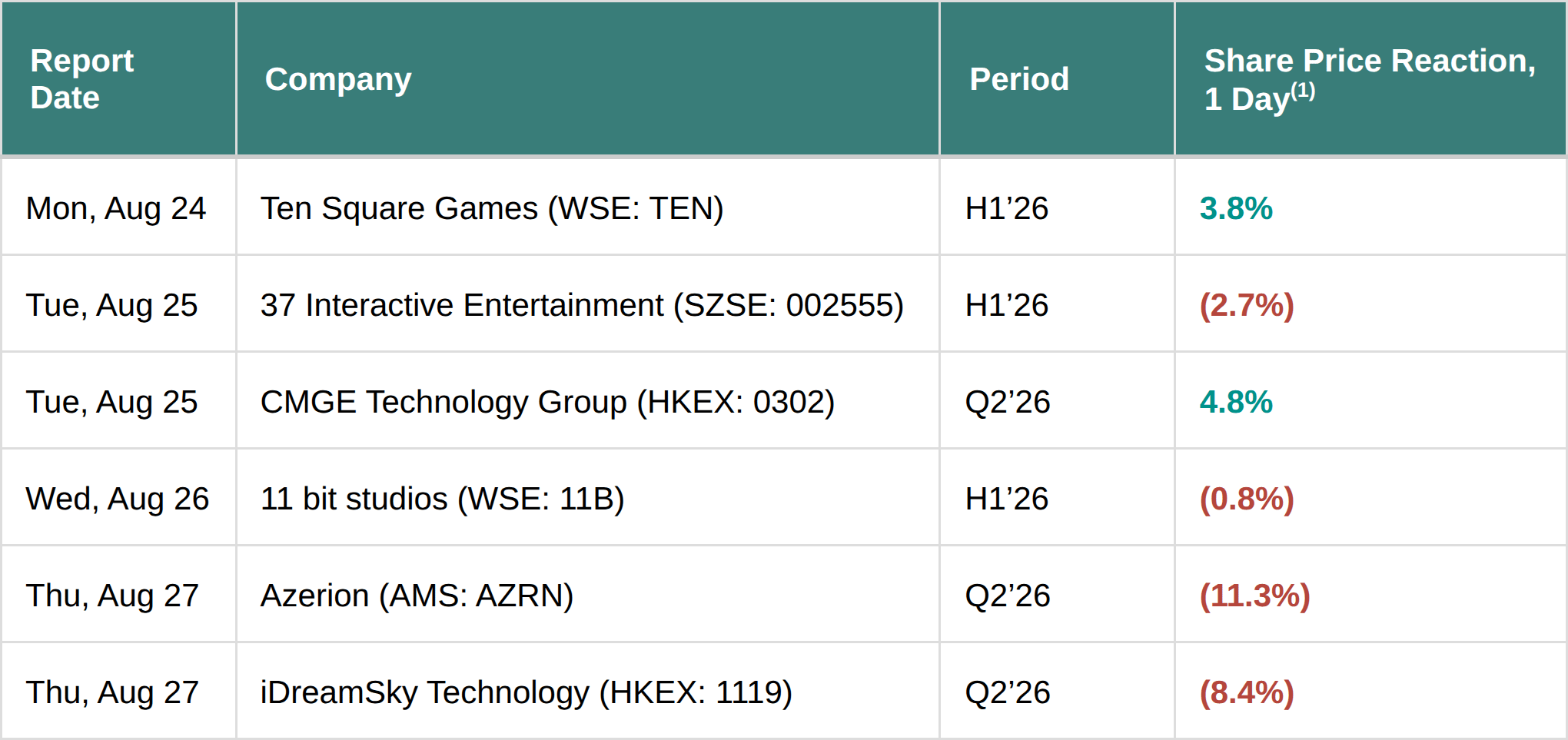
(1) Close-to-close move straddling the report date, recomputed from exchange closes. Azerion published before its own market opened, so the reaction is to the report itself. 37 Interactive Entertainment, 11 bit studios, Ten Square Games, CMGE Technology Group, and iDreamSky Technology published after the close, so the baseline is the release-day close, and the reaction is the next close.
Source: company releases and exchange closing prices.
Public Market Performance
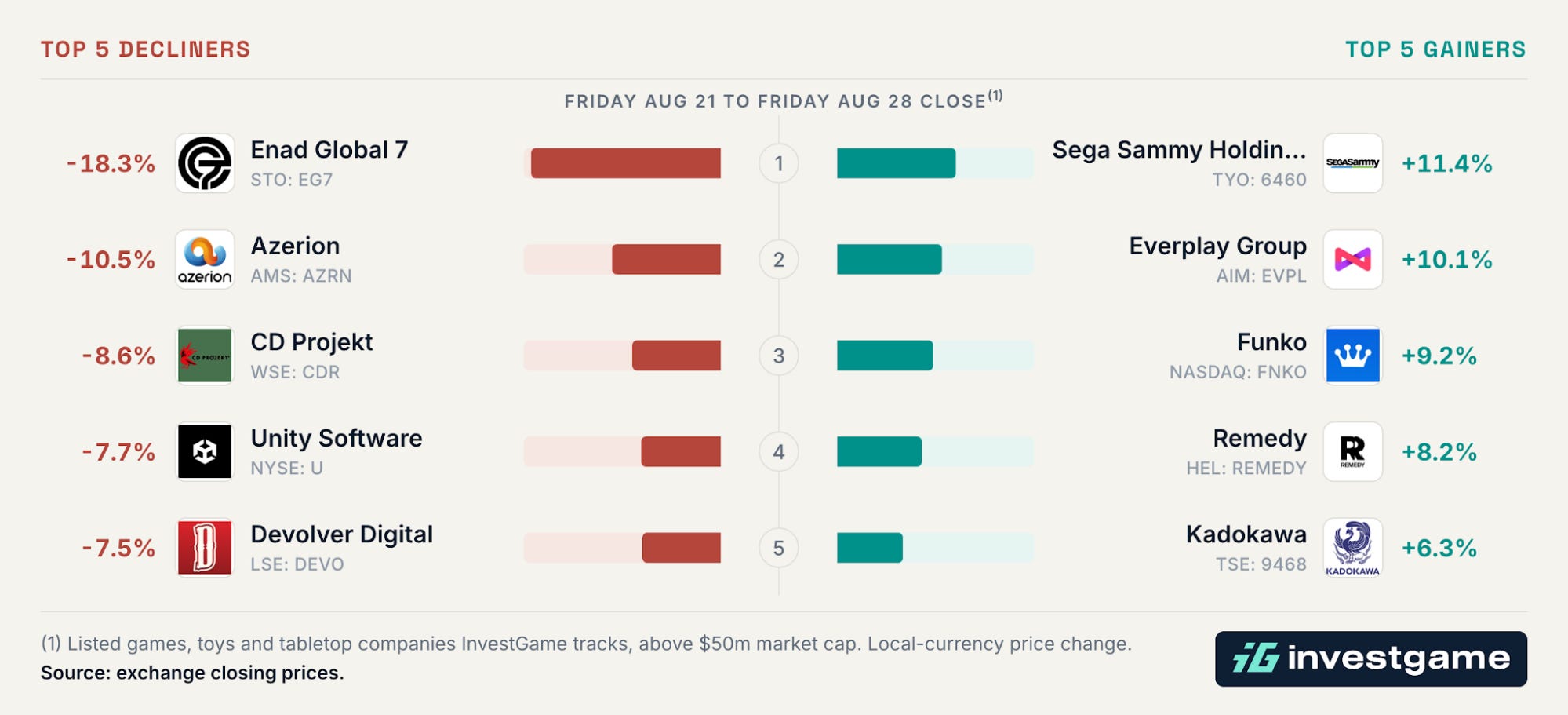
Sega Sammy Holdings (+11.45%) posted a price increase on Aug 25, when J.P. Morgan Securities Japan raised its price target to JPY 3,500 from JPY 2,600, maintaining an Overweight rating and reversing its own Jun 23 cut to JPY 3,400. It was catching up with the Aug 7 first quarter, where the group beat its own operating plan by more than $44m (JPY 7B), split roughly evenly between its games business and its pachinko and pachislot machines.
Everplay Group (+10.10%) rose during gamescom week, with no RNS filings in the window. Its Team17 label revealed Worms: Galactic Tactics at Opening Night Live on Aug 25 and unveiled Bossa Games’ multiplatform What Goes Up on Aug 27. Neither is a regulatory disclosure, so the move reads as gamescom-week sentiment rather than a single-priced event.
Funko (+9.23%) jumped 5.8% on Aug 24 after Seaport Global initiated coverage at Buy with an $8 price target, citing rapid growth in the collector market and Funko’s international expansion of Pop! collectibles. Shares closed the day at $6.88, a new 52-week high, extending the rally from the Aug 6 second-quarter beat that swung the company to an adjusted profit and lifted full-year EBITDA guidance to $100m-$110m.
Remedy Entertainment (+8.16%) climbed in each of the three sessions from Aug 25, a cumulative 7.5%, on its gamescom showing for CONTROL Resonant. The “Altered State” trailer premiered at Opening Night Live on Aug 25, and the game’s first public playable build followed on the show floor the next day. It launches on Sep 24, carrying more than 1.5 million wishlists. The heavier move this month was driven by the Aug 11 half-year report, which lifted the stock 9.3%: H1 revenue fell 23.1% to $27.1m (EUR 23.3m), but the outlook for higher full-year revenue and EBITDA held. Sole covering broker Inderes has had a Buy at EUR 21.00 since Aug 12.
Kadokawa (+6.32%) rose after a Nikkei analysis on Aug 26 used a sum-of-the-parts model to argue the market is pricing in roughly JPY 200B of intellectual-property value beyond the company’s underlying businesses, even as full-year net profit fell 83% to JPY 1.2B. The piece ties the premium to Kadokawa’s capital and business alliance with Sony Group, which became its largest shareholder in a JPY 50B stake deal.
Enad Global 7 (-18.27%) fell after Aliens: Fireteam Elite 2 launched on Aug 25 to a mixed reception. EG7 has put $37.4m (SEK 356.3m) into the title over three years, its largest capitalized investment. Six days before launch, it told the market that it “has received positive early feedback ahead of launch”. The game opened at 56% positive on Steam, recovered to 63%, is still banded as Mixed, and peaked at 7,949 concurrent players, compared with 15,568 for the 2021 original. Finwire tied the fall to criticism of stuttering, crashes, and weak AI.
Azerion (-10.48%) fell on Q2 and H1 results published pre-market on Aug 27, which cut full-year revenue guidance from around 10% growth to flat against 2025 while holding the medium-term adj. EBITDA margin target of 14% to 16%. Q2 revenue fell 5.9% to $148.3m (EUR 127.7m), and Advertising Platform revenue fell 8.7% to $119.5m (EUR 102.9m), yet that division’s EBITDA rose 20.5% to a record on cost cuts taken earlier, and group H1 operating loss narrowed 65.5%. Management attributed the pressure to cautious advertisers, a product-mix shift, and publishers’ loss of traffic in the AI era.
CD Projekt (-8.58%) fell after joint CEO Michal Nowakowski said on the evening of Aug 24 that The Witcher 4 is targeting 2028, the first window the company has ever named. That pushes its largest revenue event out a year while costs keep accruing on the 513 of 975 developers assigned to the title. The sell side was already at 2028, so this is investors repricing a 2027 hope. Noble Securities said the slip puts the 2024-27 incentive targets out of reach and puts production plus marketing costs near $778m, which are expected to rise. H1 results follow on Sep 2.
Unity Software (-7.71%) gave back some of its post-earnings run, with no company news this week. What moved was the sector: a tech sell-off on Aug 24 and hotter US inflation on Aug 26 pushed AI-disruption fear into enterprise software. Intuit, which had issued weak FY’27 guidance the evening before, dropped as much as 12% in premarket trading on Aug 26 before closing down 3.2% for the session. At $43.31, Unity’s stock is still 22.1% above its close before the Aug 6 second-quarter report, which beat on revenue and raised guidance.
Earnings Calendar: The Week Ahead

(1) Dates are issuer-set and subject to change.
good!
great stuff!