Private equity circles Xbox after five straight quarters of falling revenue
A group of unnamed private equity firms weighed a buyout of Xbox, the gaming division of Microsoft (NASDAQ: MSFT), at a valuation of $100.0B to $150.0B, The Information reported on Oct 20, citing people familiar with the discussions. The talks were exploratory and never reached a negotiation with Microsoft, and Xbox CEO Asha Sharma had said on Sep 30 that “Xbox is not for sale.” Netflix (NASDAQ: NFLX) separately offered $500m for seven years of Xbox film and TV rights; Xbox countered at $800m, and Netflix withdrew, Puck reported on Oct 23.
The interest comes as the business shrinks. Xbox revenue rose 9% to $23.5B in the fiscal year to Jun’25, the first full year with Activision Blizzard, then fell 7% to $21.8B in the year to Jun’26. Every quarter since Q3’25 has come in below the year before, five in a row, and Q3’26 fell 2% to $5.4B, roughly where the decline started.
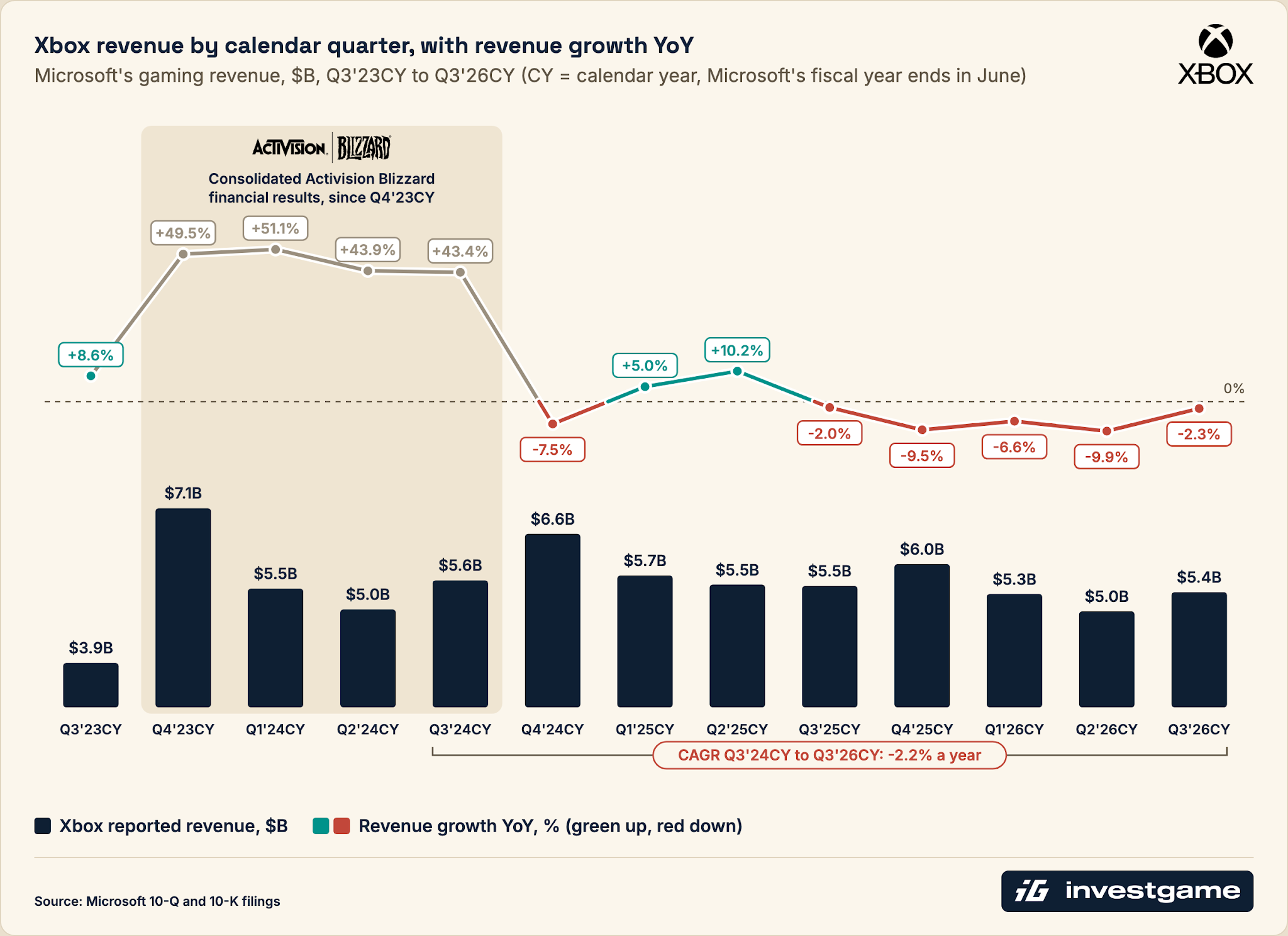
Consoles led the slide: hardware revenue fell year over year in every quarter Microsoft has reported since Q3’24, by as much as a third, on lower console volumes, after Microsoft raised US console prices in May’25 and again in Oct’25. Content and services, which carry Game Pass and Microsoft’s own games, turned negative in Q4’25 and fell 10% in Q2’26. Game Pass Ultimate went from $19.99 to $29.99 a month in Oct’25, and Microsoft cut it to $22.99 in Apr’26.
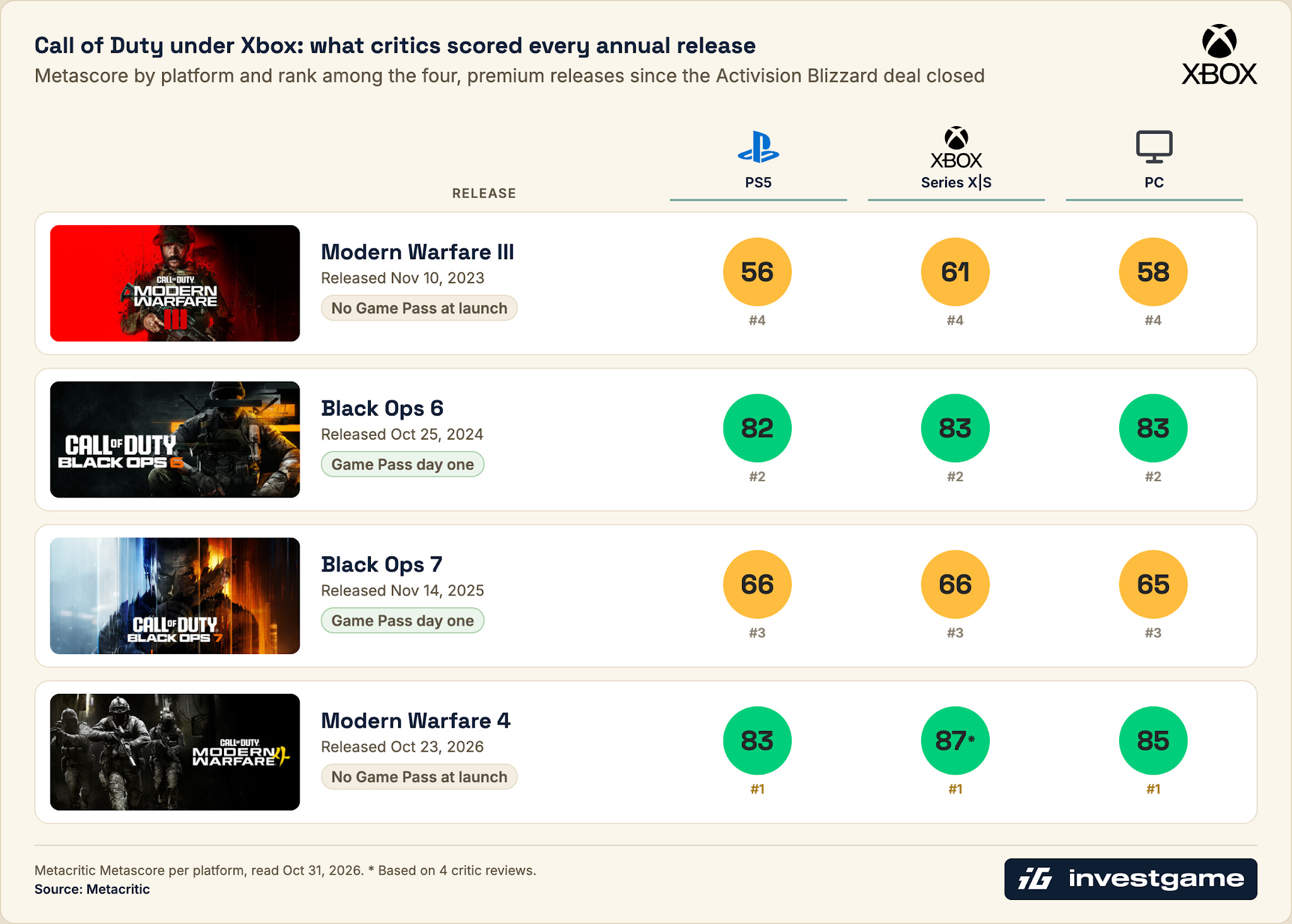
Call of Duty, the franchise Microsoft bought with Activision Blizzard, has turned around under Xbox. Modern Warfare III, the first release after the deal closed, became the lowest-rated game in the series’ history on Metacritic in Nov’23, and Black Ops 7 slipped again in 2025 after a Black Ops 6 rebound. Modern Warfare 4, released on Oct 23 outside Game Pass, is now the best-reviewed of the four on every platform and took $91.1m on Steam in its first seven days, ahead of Black Ops 6 ($79.1m), according to Alinea Analytics estimates.
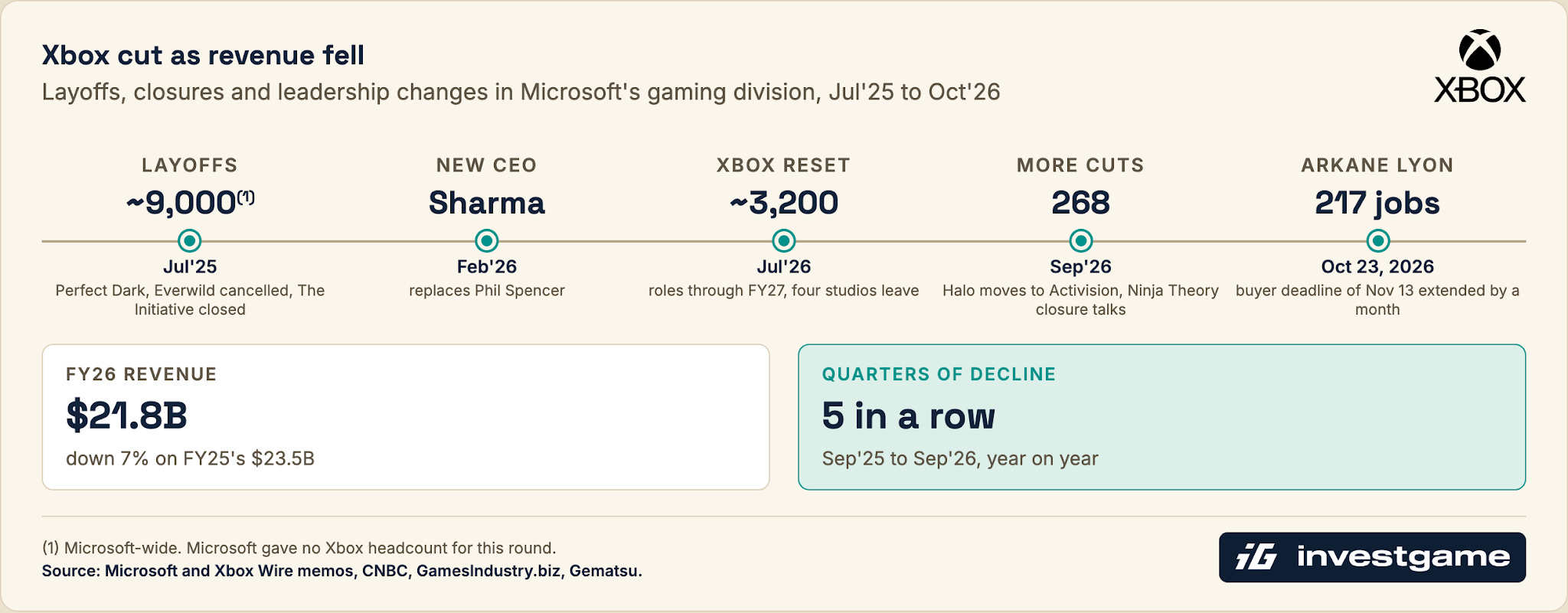
The cuts followed the revenue. In Jul’25, during a Microsoft-wide round of ~9,000 job cuts, Xbox canceled Perfect Dark and closed its developer, The Initiative, while also canceling the adventure game Everwild. Asha Sharma, who replaced Phil Spencer in Feb’26, announced ~3,200 job cuts through FY27 on Jul 6 and moved four studios out of Xbox. Another 268 roles went on Sep 22, when the Halo shooter series moved to Activision, Ninja Theory entered closure talks, and Arkane Lyon’s Nov 13 deadline to find a buyer was extended by a month. Microsoft expects content and services to return to mid- to high-single-digit growth in Q4’26.

Xsolla Web Shop is a direct-to-consumer storefront solution built for game developers.
It lets studios sell in-game items, currency, and bundles directly to players, bypassing app store fees and keeping more revenue. You can launch a ready-made shop in under 24 hours or build a fully branded, customized storefront with no integration cost. It comes with built-in liveops tools, referral mechanics, localized pricing, and flexible authentication to convert and retain players. Over 700 web shops have already launched on the platform.
Notable Transactions
MERGERS & ACQUISITIONS
US-based video game commerce company Xsolla has acquired Italy-based web games platform GamePix for an undisclosed sum. The deal was announced on Oct 29, and Xsolla has owned GamePix since Aug’26. Founded in 2013, GamePix publishes and distributes browser games on its own site, in its apps and through partners, with a catalog of more than 10,000 web titles and a community of more than 4,000 developers. It also ports Unity and C++ games to the web and publishes games built with AI tools.
US-based film and television studio Sony Pictures Entertainment (TYO: 6758) has acquired the feature film rights to the first-person psychological horror game Mouthwashing from Sweden-based indie games developer Wrong Organ and Cyprus-based games publisher Critical Reflex for an undisclosed sum. Karyn Kusama is attached to direct from a script by Matt Manfredi and Phil Hay. Released on PC in Sep’24, Mouthwashing has grossed $6.1m on ~652,000 Steam copies, according to Alinea Analytics estimates, and is 95% positive across more than 39,000 Steam reviews in all languages. It launched on PS5, PS4, Xbox Series and Switch on Oct 29, the day of the announcement.
VENTURE FINANCING
South Korea-based chatbot game messenger company AIZ Entertainment has raised $14.9m (KRW 20B) in a Series A from Kakao Games (KOSDAQ: 293490) and Krafton (KOSPI: 259960), split equally between the two. Founder and CEO Namkoong Whon was CEO of Kakao (KOSPI: 035720) from Mar’22 to Oct’22 and earlier its chief game officer. AIZ will explore business cooperation with both investors in Korea and abroad. Proceeds go to a standalone messenger app, with an open beta planned in Japan in Nov’26. The text RPG Sword Raising, which AIZ runs as a chatbot inside Kakao’s messenger, has reached 1.5 million cumulative users and more than 300,000 daily users, the company says. The round follows an $11.6m (KRW 16B) Seed in 2024.

India-based social brain games platform Matiks has raised $10m in a pre-Series A round led by General Catalyst, with Info Edge Ventures, Tanglin Venture Partners, Untitled Ventures and angel investor Ronnie Screwvala. Tanglin led a $3.1m round in Aug’25. Matiks says more than 300,000 people play daily, double the June level, and that 2.2 million people played 48 million games in Sep’26. The funds go to expansion in the US and an AI platform that lets users build and publish games without code. Sudhanshu Bhatia, Sushant Timmapur, and CTO Mohan Kumar founded it in 2024.
Japan-based esports English-learning company Gecipe has closed its final Series B round, bringing the Series B to $4.2m (JPY 660m) across both closes, including loans. Existing shareholder Nippon Venture Capital invested again. Kyoto Capital Partners, Colopl Next, SBI Okasan Alternative Investment, Resona Bank and Japan Finance Corporation joined as new investors or lenders. The proceeds fund hiring and preparation for a stock market listing.
India-based esports and gaming tournament platform Let’s Game Now has raised $3.2m (INR 30 crore) in a round backed by industrialist Anand Mahindra and a UAE-based family office. India-based investment advisory firm Bestvantage Investments advised on the round. The funds go to the Indian Super Gaming League, a franchise-based esports league with city-linked teams and a season format. Let’s Game Now says it has organized more than 2,000 events and reached over 50 million people in more than 18 countries. Santanu Basu founded it in 2018.
India-based trivia and puzzle app dubdub has raised $1.3m in a Seed round co-led by 3one4 Capital, Antler and Stellaris Venture Partners. The app serves questions and mini-games as a swipe feed. Co-founders Kaustubh Priye, CEO, and Supan Shah launched it in Mar’26, and dubdub says it has passed 20,000 downloads. The funds go to hiring in product and engineering and to new interactive formats.
Google Play, a unit of Alphabet (NASDAQ: GOOGL), has selected 10 Sub-Saharan Africa studios for its first Indie Games Fund Africa, a $1m non-dilutive fund with $50k to $200k per studio. The studios also get mentoring from Google Play and technical support from Unity. The South Africa-based studios are Clockwork Acorn, Disputed People Games, Studio Bo, and Vetkoek Studios. The Nigeria-based studios are Deluxe Creation Studios, Fer Factor, Gazuntype Entertainment, and Maliyo Games. Leti Arts is based in Ghana, and Weza Interactive Entertainment is based in Kenya. Google Play’s Indie Games Fund committed $8m to Latin American studios over four years to 2025.
PUBLIC OFFERINGS
Poland-based games developer and publisher CI Games (WSE: CIG) has signed a $31.9m (EUR 28.6m) syndicated term loan with Erste Bank Polska and BOS Bank, 80% guaranteed by the Polish export credit agency KUKE. The loan first repays CI Games’ existing bank loans, then funds operations, including completing the action RPG Lords of the Fallen II, which moved to 2027, and matures in Aug’27. CI Games ended its publishing deal with Epic Games in May’26 and now self-publishes the game. The first Lords of the Fallen has sold more than 2.5 million copies since 2023.
EARNINGS REPORTS
Public Market Performance
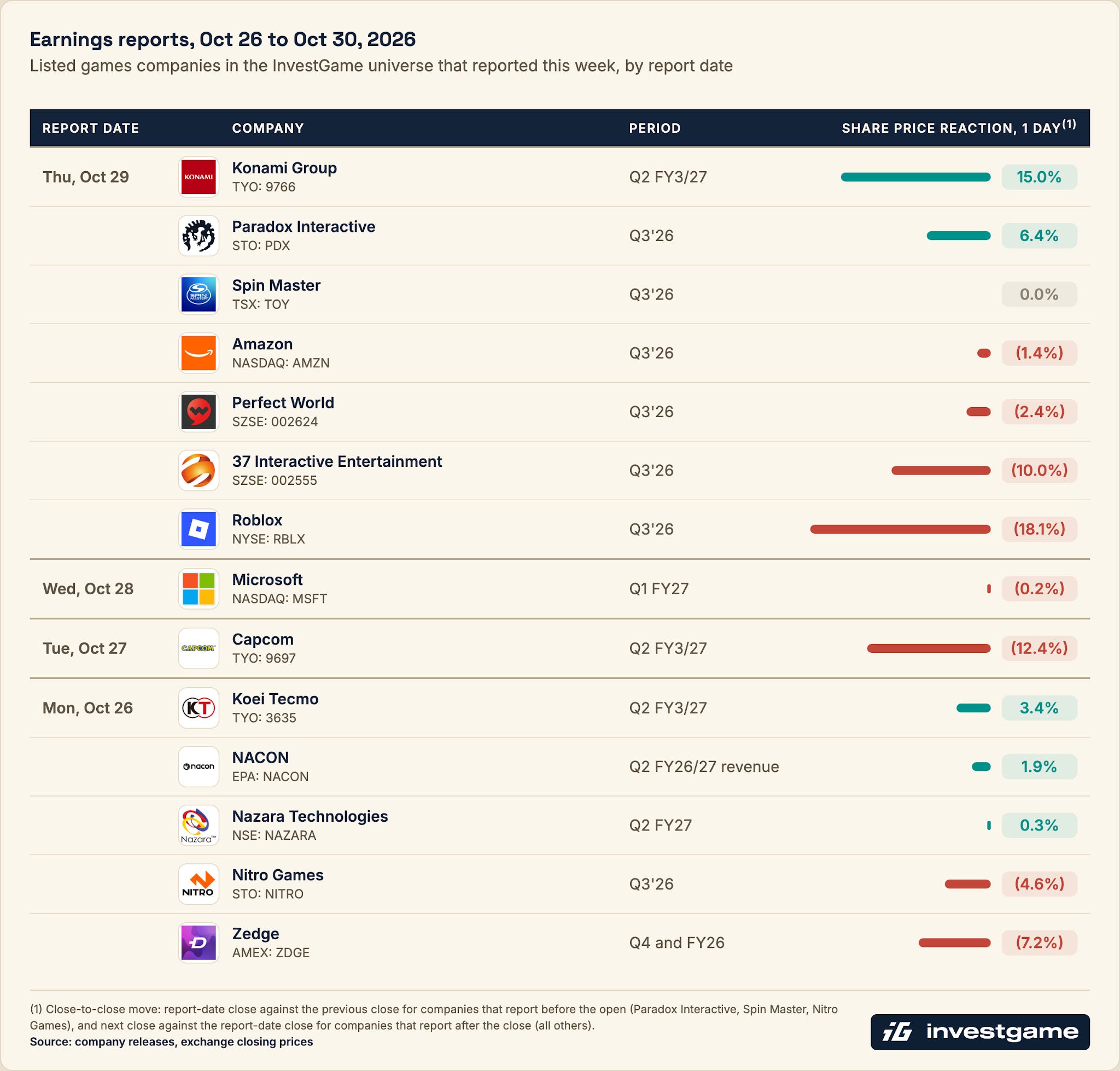
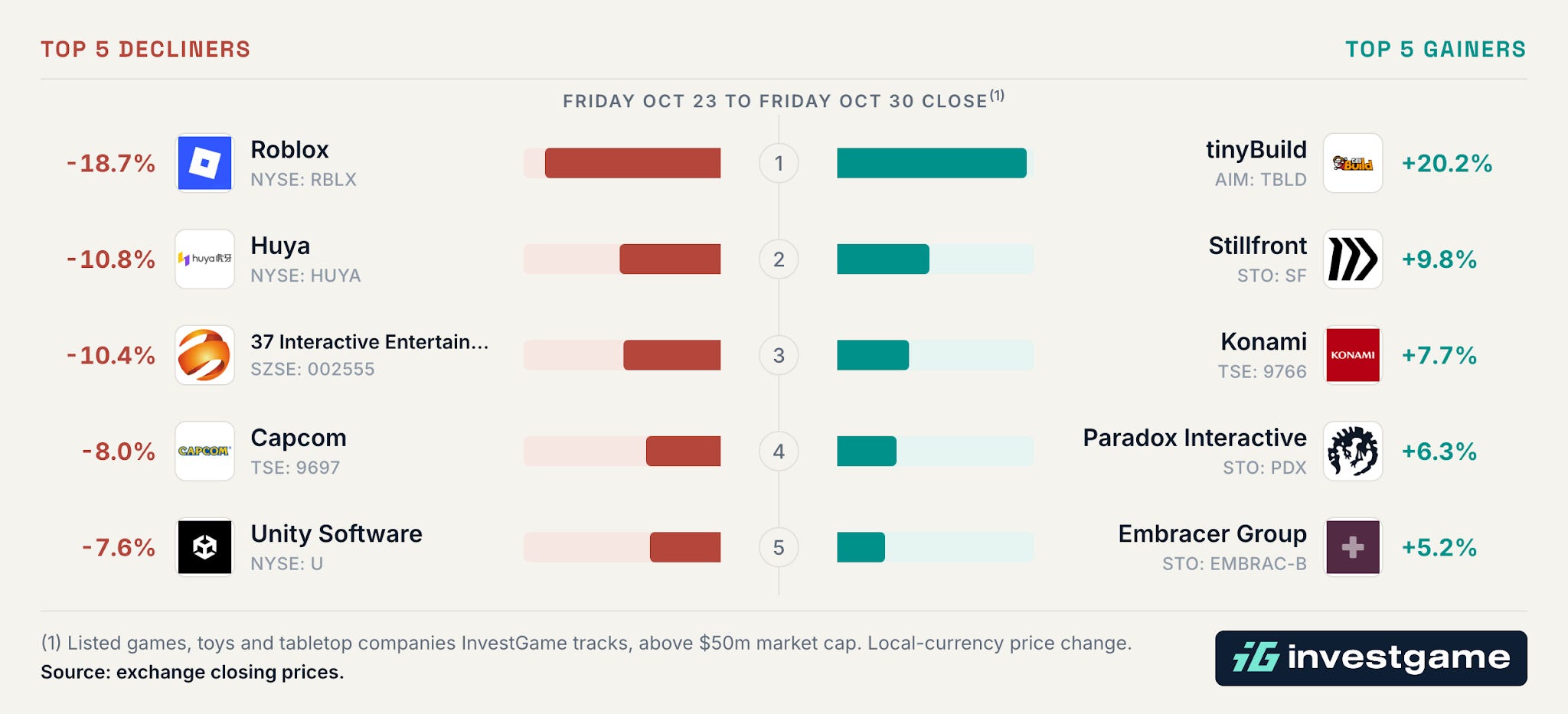
Of 63 eligible companies in the tracked universe, 19 rose, 42 fell, and 2 were flat, with a median move of -1.7%, over the Friday, Oct 23 to Friday, Oct 30 window.
Share Price Signals
tinyBuild (+20.2%) launched the cyberpunk shop simulator Probably Stolen on Steam on Oct 28 at $19.99, with 500,000+ wishlists behind it and more than 660,000 players in its Next Fest demo. The game sold more than 350,000 copies in its first 24 hours and peaked at 112,145 concurrent players on Oct 29, a tinyBuild record. On launch day, it ranked No. 2 on Steam’s global top-grossing list with 95% positive reviews, App2Top reported.
Stillfront (+9.8%) recovered part of an 18% fall over Oct 22 and Oct 23, the day it reported Q3. Net revenue of $130m (SEK 1,291m) and adjusted EBITDAC of $37m (SEK 366m) beat the consensus of $127m (SEK 1,266m) and $36m (SEK 360m), though revenue fell 6% and organic growth was -1%. On Oct 26 Pareto raised its target to SEK 10 from SEK 9.50 and kept Buy, while SB1 Markets cut its target to SEK 7 from SEK 7.50 and kept Neutral.
Konami (+7.7%) reported first-half results after the Tokyo close on Oct 29, and the shares rose the next session. Revenue rose 37% to $1.95B (JPY 308.0B) and operating profit rose 73% to $704m (JPY 111.3B), as Digital Entertainment revenue grew 44% on the football game eFootball and the Yu-Gi-Oh! card game. July-September operating profit of $418m (JPY 66.0B) beat the ~$316m (JPY 50B) expected, Fisco reported. Konami raised full-year operating profit guidance to $1.22B (JPY 193B) from $905m (JPY 143B).
Paradox Interactive (+6.3%) reported Q3 on Oct 29, and the shares rose that day. Revenue rose 15% to $47m (SEK 456m), and operating profit rose 27% to $15m (SEK 142m), against a Bloomberg consensus of $11m (SEK 105m). The profit includes a one-off $4m (SEK 40m) gain from selling Playrion to Trophy Games.
Roblox (-18.7%) reported Q3 after the US close on Oct 29, and the shares fell the next session. Revenue rose 16% to $1.57B and bookings of $1.7B, down 12%, beat Roblox’s own guidance, but daily active users fell 9% to 138m and hours engaged fell 15%. Q4 bookings guidance of $1.89B to $2.00B, down 10% to 15% on the year, has a midpoint below the $1.98B analysts expected, Bloomberg reported. Morgan Stanley kept Overweight and cut its target to $50 from $55, saying the guidance disappointed expectations of a bookings recovery.
37 Interactive Entertainment (-10.4%) published Q3 results after the Shenzhen close on Oct 29, and the shares fell the next session. Revenue rose 3% to $614m (RMB 4.09B), but it posted a net loss of $44m (RMB 295.9m) after a $76m (RMB 506m) non-recurring loss from share-price movement at Zhipu, in which it holds an indirect stake. Profit excluding one-offs fell 79% to $27m (RMB 180.9m), as older titles declined and new strategy and casual launches carry front-loaded marketing, 37 Interactive said. Overseas revenue rose 59% to $326m (RMB 2.17B).
Capcom (-8.0%) fell the day after its first-half results on Oct 27, because investors had hoped for a higher forecast. The half itself was strong: sales rose 49% to $766m (JPY 120.9B), and operating profit rose 55% to $385m (JPY 60.8B). Growth slowed in July-September, though, with operating profit up 34% against 67% in the first quarter. The quarter met expectations only because amusement-equipment sales were brought forward, while sales of older games were weak, Fisco said. Capcom kept its full-year operating profit forecast at $526m (JPY 83.0B), although the first half has already delivered 73% of it, and the unchanged forecast triggered the selling.
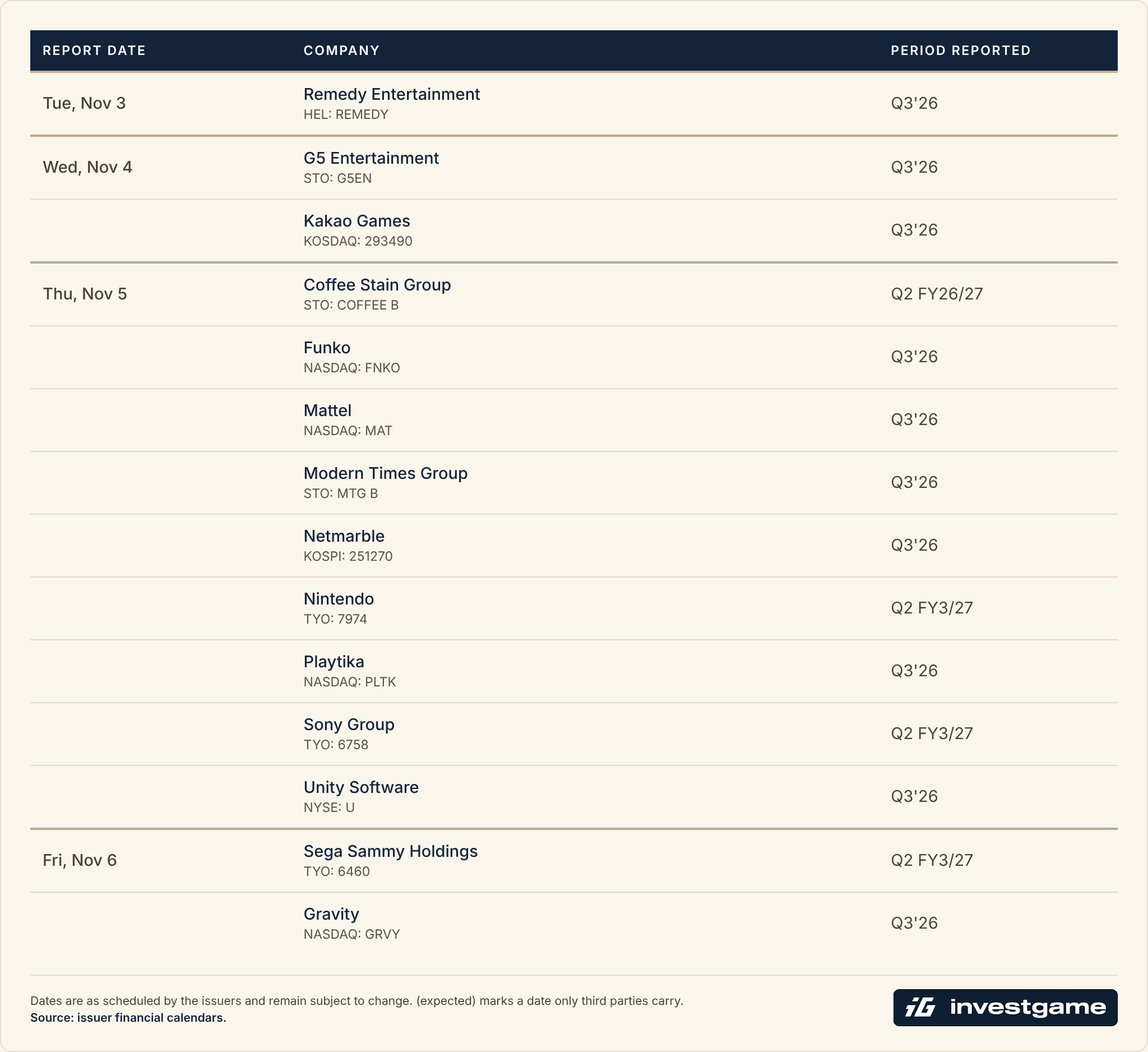
Earnings Calendar: The Week Ahead