


Every deal in this digest is checked before it reaches you. The InvestGame platform covers every deal since 2020: 17,140+ companies, 6,430+ investors and 7,790+ verified deals, updated daily.
This week’s feature is about UA financing. On the platform you’ll find 50+ UA financing deals from the last 12 months, with who funded whom and when.
Committed UA financing now exceeds early-stage equity in mobile games and consumer apps
US-based AI English-learning app Buddy.ai has secured a $15m user acquisition (UA) facility from New York-based Braavo Capital. The company draws the money as it buys users and repays each advance from the revenue those users generate, without giving up equity. Braavo says it has committed over $60m to facilities like this one in 2026.
Cohort financing has existed for years and has grown fast: since 2025, committed UA facilities for mobile games have become one of the dominant financing alternatives for mobile studios. In the first three quarters of 2026, they totaled $398m against $254m of early-stage rounds, so UA facilities made up 61% of the combined $652m. Studios that once sold equity to pay for installs can now fund them from the revenue of the users they acquire, and keep their equity for product and hiring.
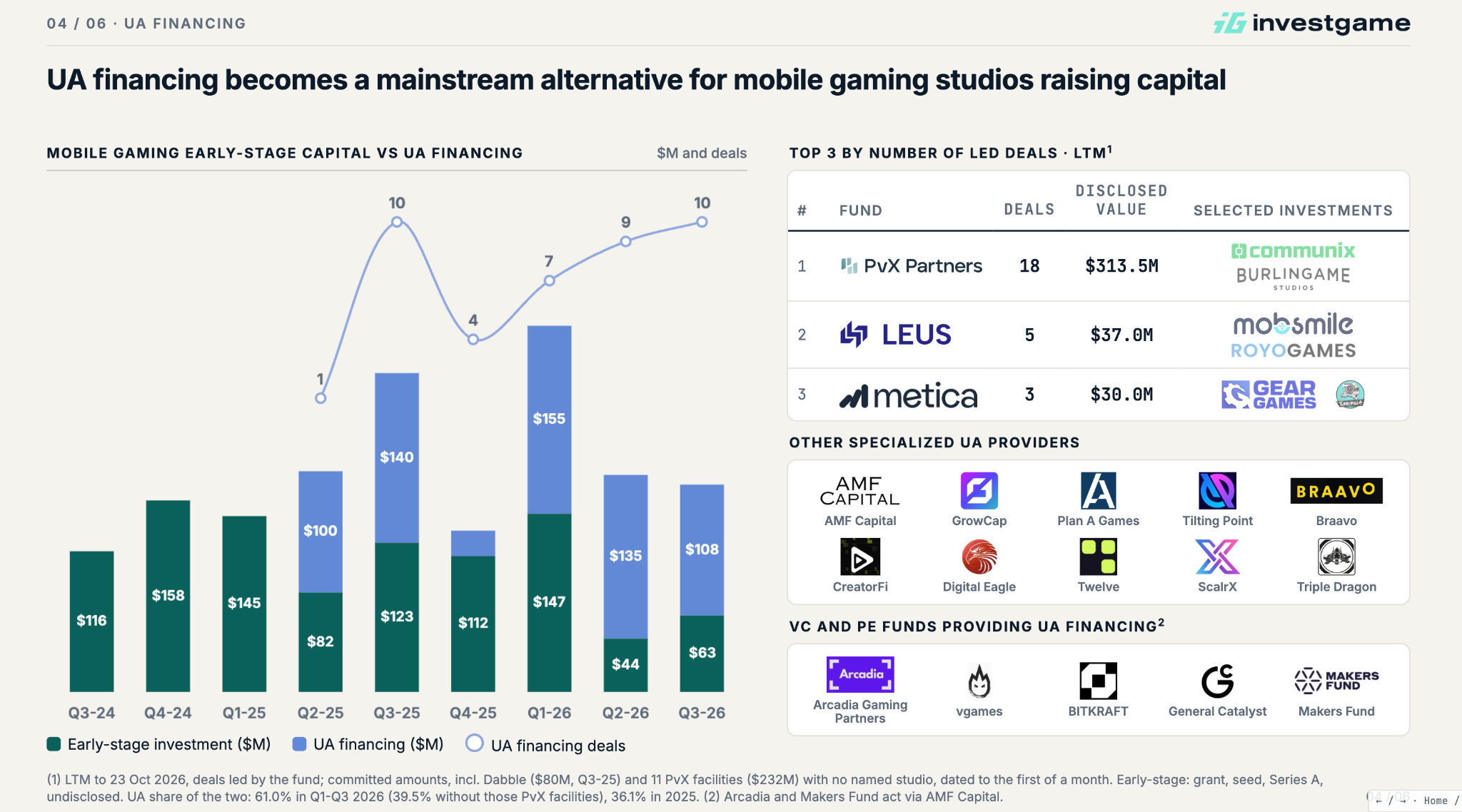
Terms differ by provider. PvX Partners is repaid through a share of the revenue of the cohorts it funds, up to a return cap agreed in advance, while Plan A Games charges a fixed interest rate on the capital the studio draws, plus a success fee if the game reaches a revenue target set at the start.
General Catalyst has the largest balance sheet behind the model. Its Customer Value Fund provides the balance sheet for PvX, the most active provider, and General Catalyst also invests in it. Through the same fund, General Catalyst financed SuperPlay’s UA without taking equity, and SuperPlay CEO Gilad Almog called the product “almost like a secret weapon”. In 2024, Playtika (NASDAQ: PLTK) agreed to acquire the Israel-based studio for $700m upfront plus up to $1.25B in earn-outs. Today, General Catalyst deploys mostly through partners: PvX announced more than $250m of committed facilities for 20 mobile game and consumer app companies in Dec’25, rising to over $750m by Apr’26, while Israel-based vgames had deployed over $350m into UA and marketing financing by Dec’25 and targets a further $500m over the following 12 months.
Capital is also changing beyond mobile. A wave of new funds now backs game ideas: Griffin Gaming Partners launched a $100m fund in May’26 that pays for indie games in exchange for a share of each game’s revenue; Denmu, led by Ryan You and Michael Fan, has secured most of the commitments for a $50m fund that finances specific games rather than studios, mixing project financing with equity, with typical checks of $1–5m; and Simon Zhu launched GreaterThan Group, a holding company in which studio leads hold equity in both their studio and the parent, with $40m raised and around $60m of further commitments.
Money once used to fund installs through an equity round now comes from lenders, and in 2026 it already accounts for most of the total.
Notable Transactions
MERGERS & ACQUISITIONS
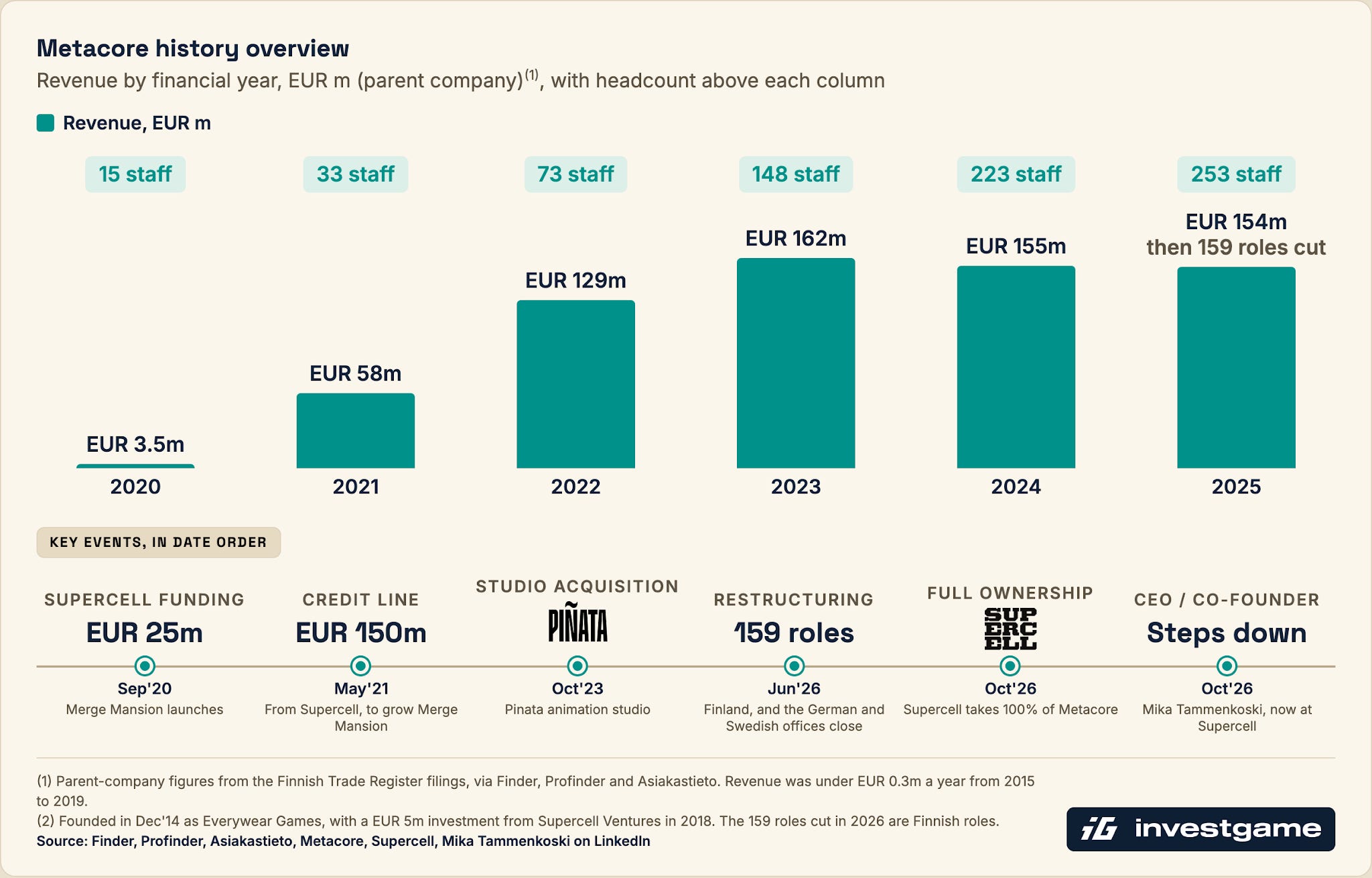
Finland-based mobile games developer Supercell has closed its acquisition of Metacore, the developer of the merge-puzzle game Merge Mansion, taking it to 100% ownership for an undisclosed sum. Supercell was already Metacore’s largest shareholder. Supercell CEO Ilkka Paananen said at the May’26 announcement that Supercell can help the game “climb back to the top of its category.” Metacore has not grown since 2023, when revenue was $175m (EUR 162m), against $174m (EUR 154m) in 2025, with an operating profit of $26m (EUR 23m). Merge Mansion pioneered the merge-2 genre and led it by revenue for 3.5 years, per AppMagic, then was overtaken by Travel Town from Israel-based Moon Active, and Gossip Harbor and Seaside Escape from China-based Microfun. Gossip Harbor has led the genre since late 2024, and Merge Mansion ranked seventh among merge games worldwide in Jan-Apr’26. The restructuring Metacore announced with the deal ended with 159 roles cut in Finland and the closure of its German and Swedish operations. Mika Tammenkoski, Metacore co-founder and CEO, left on Friday, Oct 16, and is now a Senior Advisor at Supercell.
VENTURE FINANCING
According to an SEC filing, US-based ad-tech company Monetizr has raised $875k of a planned $2m from five undisclosed investors. The company runs an advertising and data platform for mobile games.
NON-DILUTIVE FINANCING
Kazakhstan-based AI consumer apps developer Nomad Venture Studio has secured a UA financing facility of up to $100m from Singapore-based UA financing platform PvX Partners, up from the $18m the two agreed in Mar’26. Its monthly UA spend nearly quadrupled between Dec’25 and Sep’26. Nomad builds AI consumer apps: Jobescape teaches AI skills to working professionals and, according to Nomad, earns ~$3m a month, while 7ART generates images, video and music.

Cyprus-based AI skincare app Lovi has secured a $15m committed UA cohort financing facility from New York-based UA financing platform Braavo Capital. The facility closed in Jun’26, and Lovi tripled its monthly advertising spend within two months. Lovi acquires subscribers through web-to-app funnels, and its revenue grew up to 2.1x YoY.
South Korea-based indie games developer Concode has secured development funding from Outersloth, the indie game fund run by Innersloth, for an undisclosed sum, alongside Mega Crit co-founder Casey Yano and another unnamed partner. The two-person studio will use the funds to rework combat and deepen the story and regions of the mystery action-adventure Graytail, due on PC and Xbox in late 2027. Concode keeps its IP and creative direction, will self-publish, and reports 50,000 wishlists for the game.
FUNDRAISING
Cyprus-based investment company Mika Games has raised a second $10m round led by Flint Capital, bringing total funding to $20m after an initial $10m round, also led by Flint, announced in Apr’24 as the first close of a planned $50m fund. Mika takes equity in mobile studios before their UA economics are proven and finances larger paid acquisition tests from a separate pool of capital. The portfolio grew from three to five studios in 2026, adding Bulberry Studio, developer of the mobile deck-building strategy game Wargard, and LevelApp, maker of the merge-2 game Merge Dale. Mika was founded by Wargaming co-founder Nick Katselapov, who is its CEO.
EARNINGS REPORTS
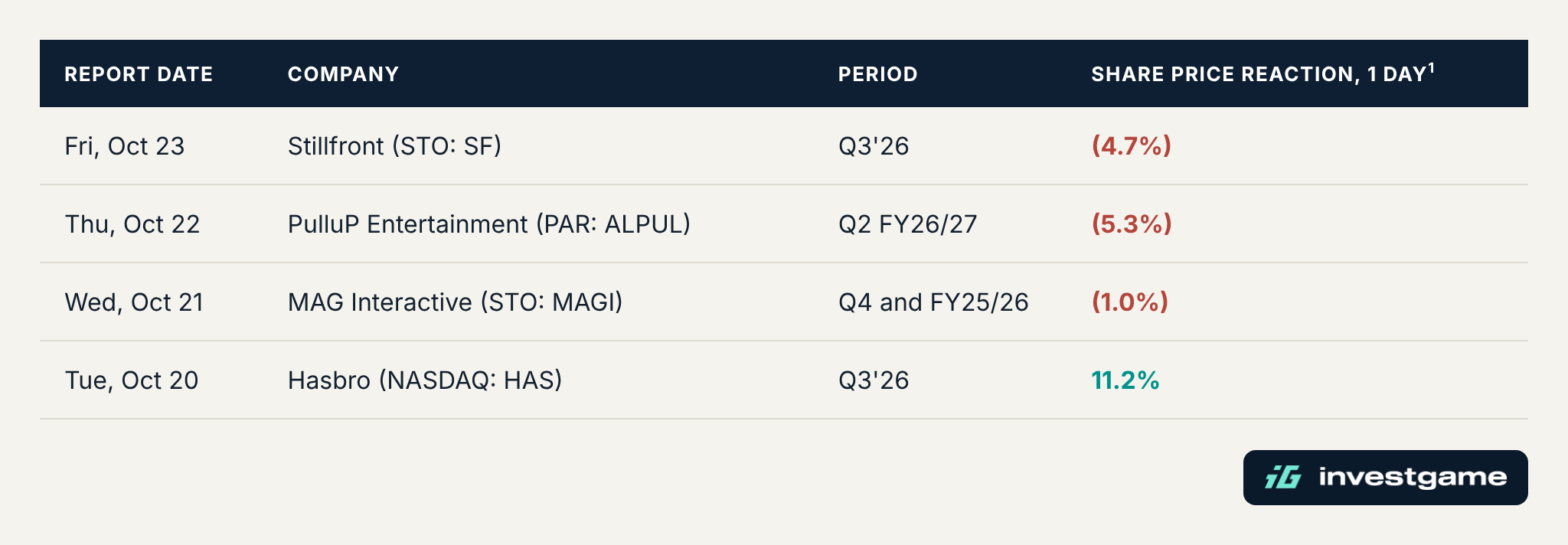
(1) Close-to-close move on the report date against the previous close for companies that report before the open (Hasbro, MAG Interactive, Stillfront), and from the report-date close to the next close for PulluP Entertainment, which reported after the close.
Public Market Performance
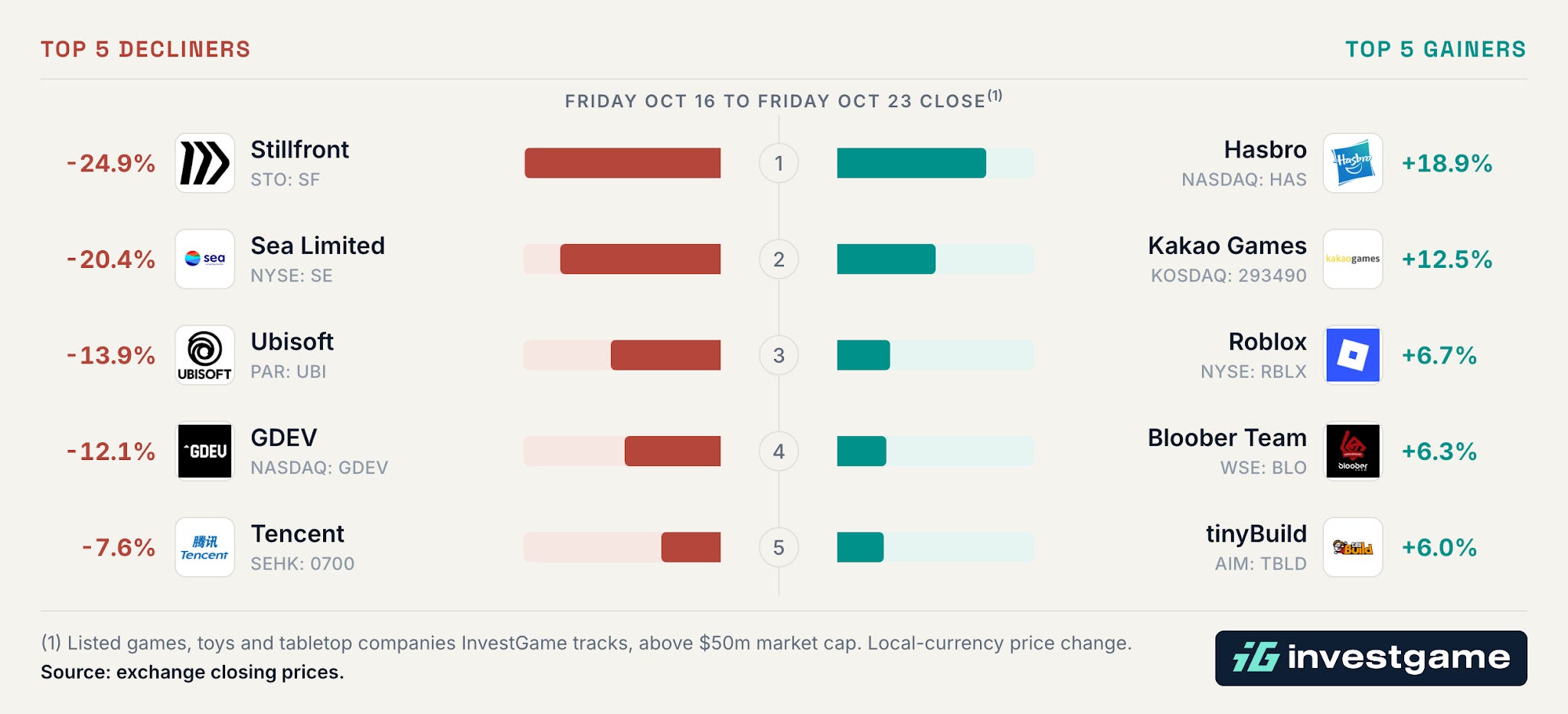
Of 63 eligible companies in the tracked universe, 22 rose, 41 fell, and none was flat, with a median move of -1.4%, over the Friday Oct 16 to Friday Oct 23 window.
Share Price Signals
Hasbro (+18.9%) reported Q3 before the open on Oct 20: revenue of $1.60B against $1.48B expected, and adjusted earnings of $2.90 a share against $1.86, including about $55m of tariff refunds. Wizards and Digital Gaming revenue rose 31% to $747m, led by Magic: The Gathering at $616m (+34%), while digital and licensed gaming grew 3%. Hasbro lifted 2026 revenue growth guidance to 7-9% at constant currency from 5-7% and doubled its share repurchase target to $400m from $200m, having bought back $149m through the first nine months. On Oct 21, Citigroup raised its target to $137 from $117, and BNP Paribas Exane raised its target to $127 from $116, while Wells Fargo kept Equal Weight and raised its target to $100 from $90.
Kakao Games (+12.5%) rose after Mirae Asset Securities upgraded it from Neutral to Buy on Oct 22 and raised its target to KRW 15,000 from KRW 9,000. Mirae expects an operating profit of $109m (KRW 145B) in 2027 against a loss of $75m (KRW 100B) this year, as new titles led by Odin Q arrive in Q1’27 and labor costs fall. The MMORPG Dokkaebi’s World, launched Oct 8, has been No. 1 on Google Play Korea revenue since Oct 13. Shares closed Oct 23 at KRW 11,550 after two other brokers raised their targets earlier in October.
Roblox (+6.7%) rose into its Q3 report, due Oct 29, as engagement data pointed to more players than expected, driven by Steal an Egg, the viral game launched in July. On Oct 23, Wedbush said its app panel points to 135 million daily active users in Q3, above its prior estimate of 125 million and the 132 million consensus, but expects bookings per daily user to fall 3.4% to $12.25, putting Q3 bookings at $1.65B, the top of the $1.58B to $1.65B guidance. Wedbush kept Neutral and raised its target to $55 from $48, saying it would turn more constructive if the retuned discovery algorithm lifts monetization.
Stillfront (-24.9%) reported Q3 before the open on Oct 23: net revenue of $130m (SEK 1,291m) against $127m (SEK 1,266m) expected, and adjusted EBITDAC of $37m (SEK 366m) against $36m (SEK 360m). EBITDAC fell 16% as Gameberry royalties ended and divestments closed, and the outgoing CEO said the strategic review remains open. After the close on Oct 22, the board named former King executive Marcus Jacobs CEO from Nov 1. Most of the week’s fall came on Oct 22, before the results, with no company news. Shares fell a further 4.7% on Oct 23 to SEK 5.62.
Sea Limited (-20.4%) fell 9.1% on Oct 20 to $80.43 after CEO Forrest Li emailed employees that its fintech arm, Monee, may go public and that Sea will launch Sea Cloud, an AI-first enterprise cloud for outside customers, Reuters reported. The email gave no timing, size, or spending figure. Benzinga said investors may be weighing the cost of building a cloud business and the loss of Monee’s growth. DBS kept Hold with a $105 target.
Ubisoft (-13.9%) fell 6.7% on Oct 22, to EUR 4.63, after BNP Paribas Exane cut it to Underperform from Neutral with a EUR 3.50 target, down from EUR 4.00. The bank said cash burn of up to $672m (EUR 600m) through FY2029 is not priced in and flagged refinancing and reorganization risks.
Tencent (-7.6%) fell 4.0% on Oct 21, to a 52-week low of HKD 393.80, after Reuters reported that ByteDance, Alibaba and Tencent had ordered over 3 million Nvidia RTX PRO 5500 cards worth more than $35B at list price. BigGo said the market read the report as a sign of strain in AI spending, after Tencent’s Q2 capex rose 176% and free cash flow turned negative. Nomura kept Buy and cut its target to HKD 659 from HKD 695, citing AI investment weighing on profit.
Earnings Calendar: The Week Ahead
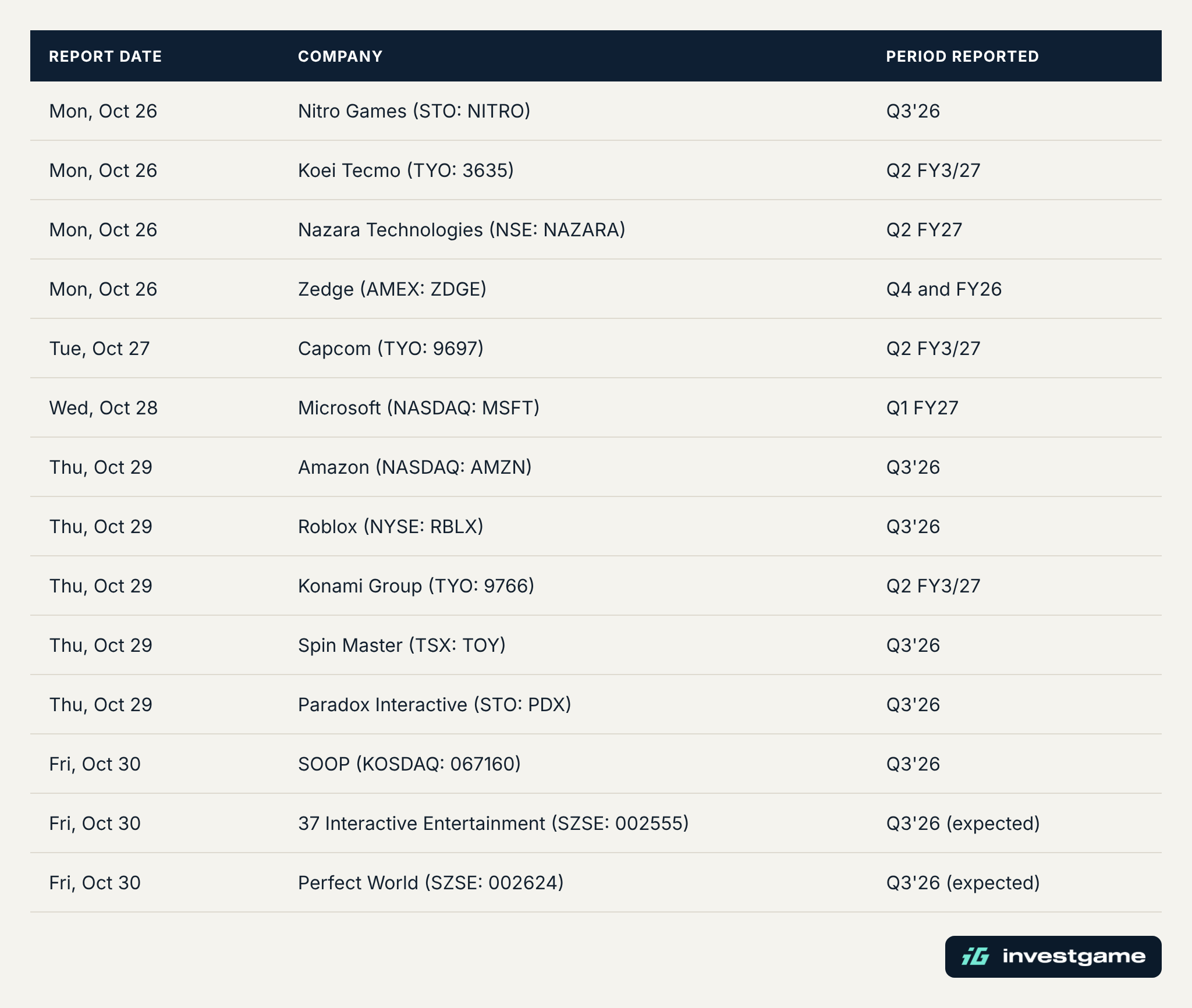
Source: issuer financial calendars. Dates are as scheduled by the issuers and remain subject to change. (expected) marks dates not yet confirmed by the issuer and taken from third-party calendars.
